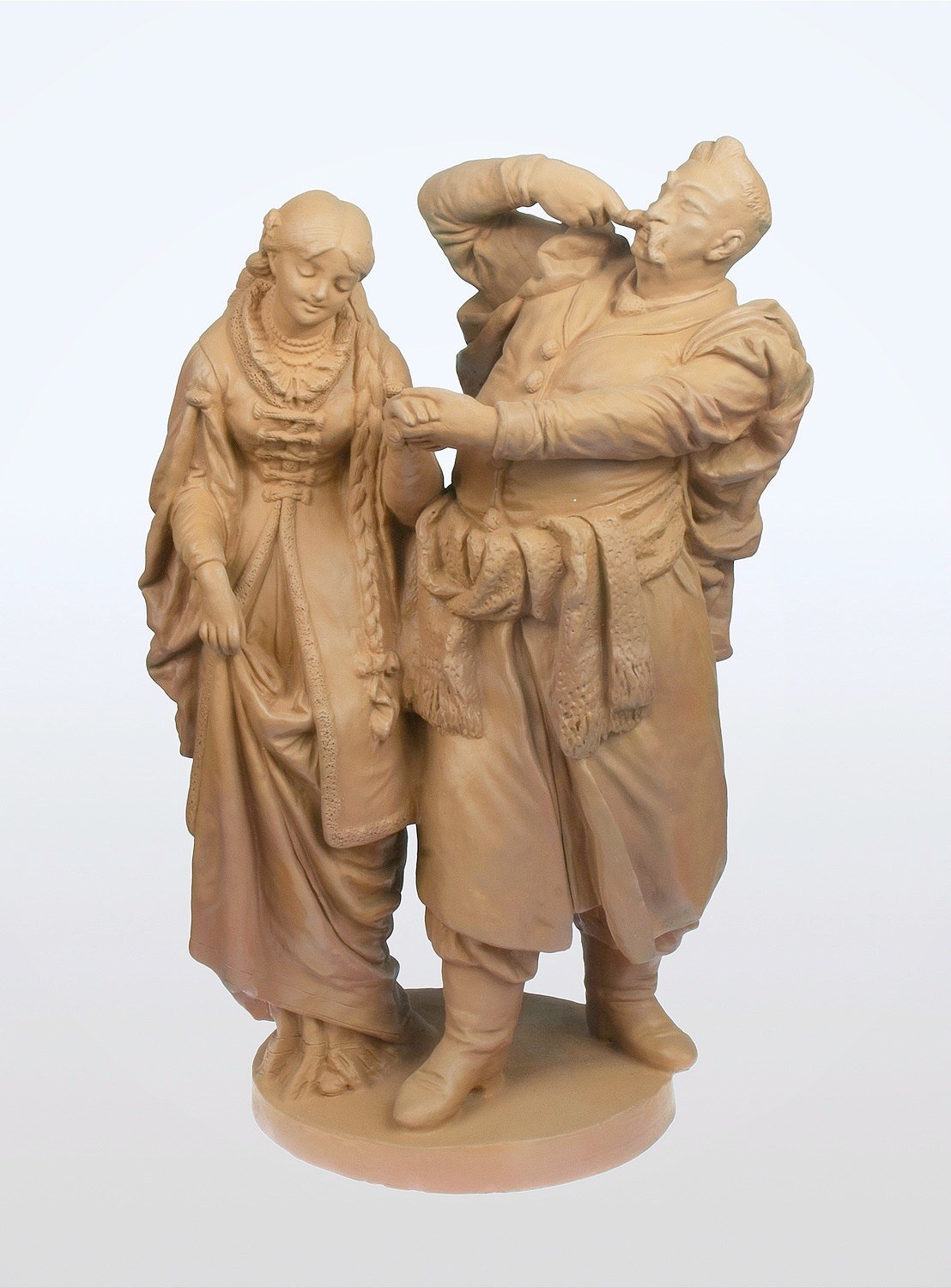
Terracotta sculpture.
Kurzawa’s “Polish Dances” series was created at the turn of the 1870s and 1880s.
Height: 51 cm
Antoni Kurzawa (Turza 1842 – 1898 Kraków) – Polish sculptor. He came from a poor peasant family; he was the son of Franciszka Kurzawa (the birth certificate lists her surname as Kurzawianka) and, according to records from the Academy of Fine Arts in Vienna, the son of a shepherd. Mieczysław Weryha Darowski made it possible for him to study at the School of Fine Arts in Kraków. From 1863 to 1869, he studied sculpture in Henryk Kossowski’s studio and drawing under the guidance of Władysław Łuszczkiewicz. From 1867 to 1868, he studied in Vienna. He then spent a short time in Lviv, where he carved at least four tombstones intended for the Lychakiv Cemetery. In 1874, after re-enrolling at the School of Fine Arts in Kraków, he was expelled on December 14 for insulting Professor Kossowski. From 1876 to 1877, he continued his studies in Paris. His sculptures were full of expression and dynamism. He sculpted religious statues in a naturalistic style, such as *Christ and Mary Magdalene* from 1864,Samson’s Fight with the Lion from 1865, The Kiss of Judas from 1867, portrait busts, and figural, mythological, and symbolic compositions such as Wawel and the Vistula from 1878, *Genius Breaking His Chains* from 1874, and genre works: *Oberek*, *Mazur*, *Polonaise*, and *The Sower* from 1896. He was the author of an unused design for a monument to Adam Mickiewicz submitted to a competition in Kraków. Kurzawa’s work includes the sculptural group *Mickiewicz Awakening the Genius of Poetry*, the original model of which was created in 1889. The work was submitted that same year to the annual competition of the Society for the Encouragement of Fine Arts in Warsaw. Confident of victory, he was devastated when the jury’s verdict was announced, awarding him third place. The first prize was not awarded. In January 1890, he committed an act of desperation—he stormed into the exhibition and smashed his own sculpture. Over time, Antoni Kurzawa became a symbol of the tragic fates of underappreciated artists. Physically frail and ravaged by illness, toward the end of his life—thanks to the efforts of his artist friends—he was admitted on June 12, 1897, to a shelter for the poor—the Helcl Institute in Kraków—where he died six months later. He was buried at the Rakowicki Cemetery (section N, eastern row). Thanks to the efforts of Leon Wyczółkowski, a sculpture by Kurzawa titled *Genius Breaking His Chains*, carved from sandstone, was erected on his grave. Many works of Young Poland literature are inspired by the drama of Kurzawa’s life, such as Henryk Sienkiewicz’s novella *Lux in tenebris lucet*. Stanisław Wyspiański and Maria Konopnicka created their works in the shadow of Kurzawa’s legacy. The Łopieńscy Brothers—a family-owned company based in Warsaw since 1862, specializing in the production of bronze, silver, and precious metal items. During the interwar period, the Łopieńscy Brothers’ products were considered among the best on the Polish market, as evidenced by the awards they received at exhibitions both in Poland and abroad, including in 1894 in Lviv, in 1929 in Poznań, and in 1925 at the World’s Fair in Paris. An important part of the company’s operations was the casting of sculptures, medals, and monuments. The painter Jan Strzałecki was the designer of many of the company’s products; artists such as Xawery Dunikowski, Cyprian Godebski, Henryk Glicenstein, Stanisław Jackowski, Antoni Kurzawa, Konstanty Laszczka, Antoni Madeyski, Czesław Makowski, Ludwika Nitschowa, Andrzej Pruszyński, Jan Raszka, Pius Weloński, and Edward Wittig also had their works cast there. After World War II, the Łopieńscy brothers’ foundry reproduced, among other things, Warsaw’s destroyed monuments.




![[MŁODA POLSKA] Antoni Kurzawa (1842 Turza -1898 Kraków) - Figura - Cykl Taniec Polski, Terakota (Rzeźba, Kraków, Folklor)](https://img1.one.bid/img/10212/3185113_1w.webp?1787401476)