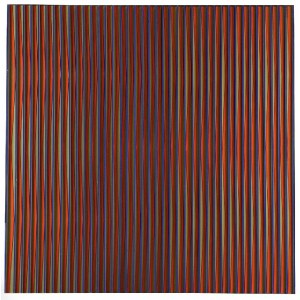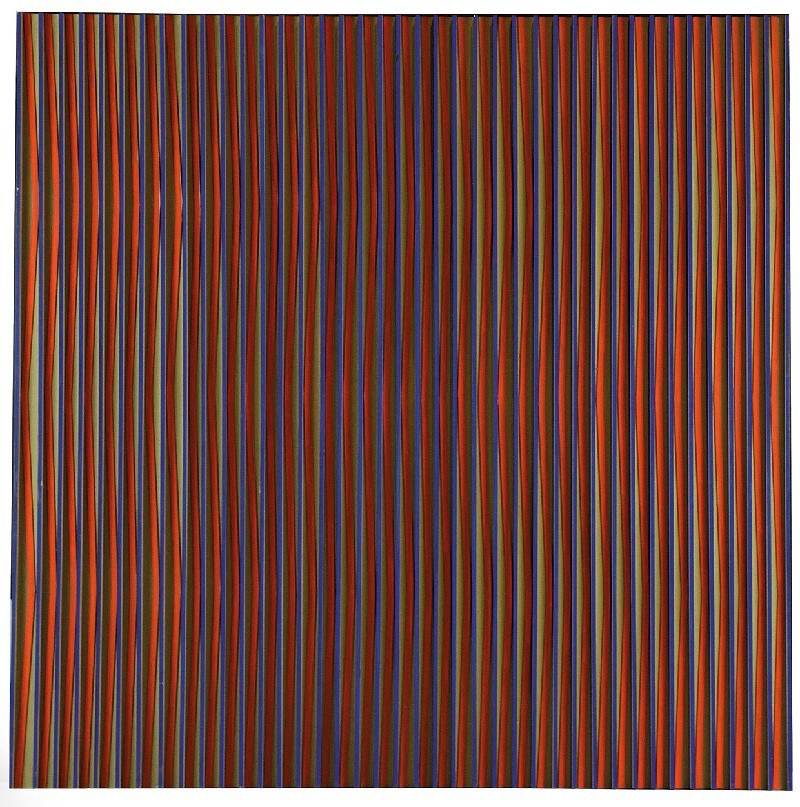
Signed, dated on the reverse: 26.05.2007 / A. Nowacki / 2007 and stamp from the collection.
Compositions of Andrzej Nowacki - is a difficult to unambiguously classify arrangement of constructivism, geometric abstraction and, as a consequence of many treatments, op-art. In 1977, the artist leaves Poland. He attends Scandinavian studies at the University of Gothenburg in Sweden and attends lectures in German studies and art history at the University of Innsbruck in Austria. He eventually settles in Berlin. In the early 1980s, he comes into contact with the Polish artistic avant-garde, which includes: Kajetan Sosnowski and Henryk Stażewski or Jan Lenica. Stażewski is a particular influence on his work. Another artist important to Nowacki is Englishwoman Bridget Riley. To complete the picture of inspiring people around the artist, it is also worth mentioning Heinz Teufel, a collector and art lover, and Bożena Kowalska, who was the organizer of open-air workshops in Okuninka for artists lavishing on geometric subjects. It was at these plein-airs that the artist participated in 1997, 1998, 2000 and 2001, also taking part in post-air exhibitions at the District Museum in Chelmno. In 2001, he was awarded a one-year scholarship from the Pollock-Krasner Foundation in New York. Simultaneously with the establishment of contact with Henryk Stażewski, Andrzej Nowacki's artistic path begins. That's when he begins to paint, in parallel he keeps an "artist's diary," a sketchbook in which he makes a dozen or so sketches in pastel or charcoal a day. This is also when the first reliefs are created. Initially they contain all sorts of forms, which are eventually simplified by the artist to vertical slats on an often square ground. This simplification is apparent at the same time as giving rise to further complications in the composition highlighted by the different thickness or height of the slats, and ultimately by color. When the form is simplified, what becomes important is the rhythm of the composition, emphasized by the above-mentioned procedures, at the same time creating further complications such as dynamics, vibrating tension or, finally, certain optical properties of the work. In the catalog of Andrzej Nowacki's exhibition, from 2003, Hubertus Gaßner writes: For all the restriction of the repertoire of forms to two basic elements - the square and the vertical straight line - the combination of the two contradictory forms of symmetry they create evokes an immanent tension and dynamism in the painting. The viewer discovers these through the sensation of the symmetry of his own body and the perception of bodily movement. Especially the reliefs created in 2001, in which an optically clear or even dominant central axis appears, are subordinated to the bilateral symmetry of the human body. By inscribing this axis of symmetry in a square, the same impression is created in an abstract dimension as the famous sketch of the proportions of the human body by Leonardo da Vinci, who inscribed it in a circle centered symmetrically with the square."
Source:https://www.porta-polonica.de/pl/atlas-miejsc-pamięci/andrzej-nowacki-rozpoznawanie-kwadratu?page=1
Source:https://www.porta-polonica.de/pl/atlas-miejsc-pamięci/andrzej-nowacki-rozpoznawanie-kwadratu?page=1