


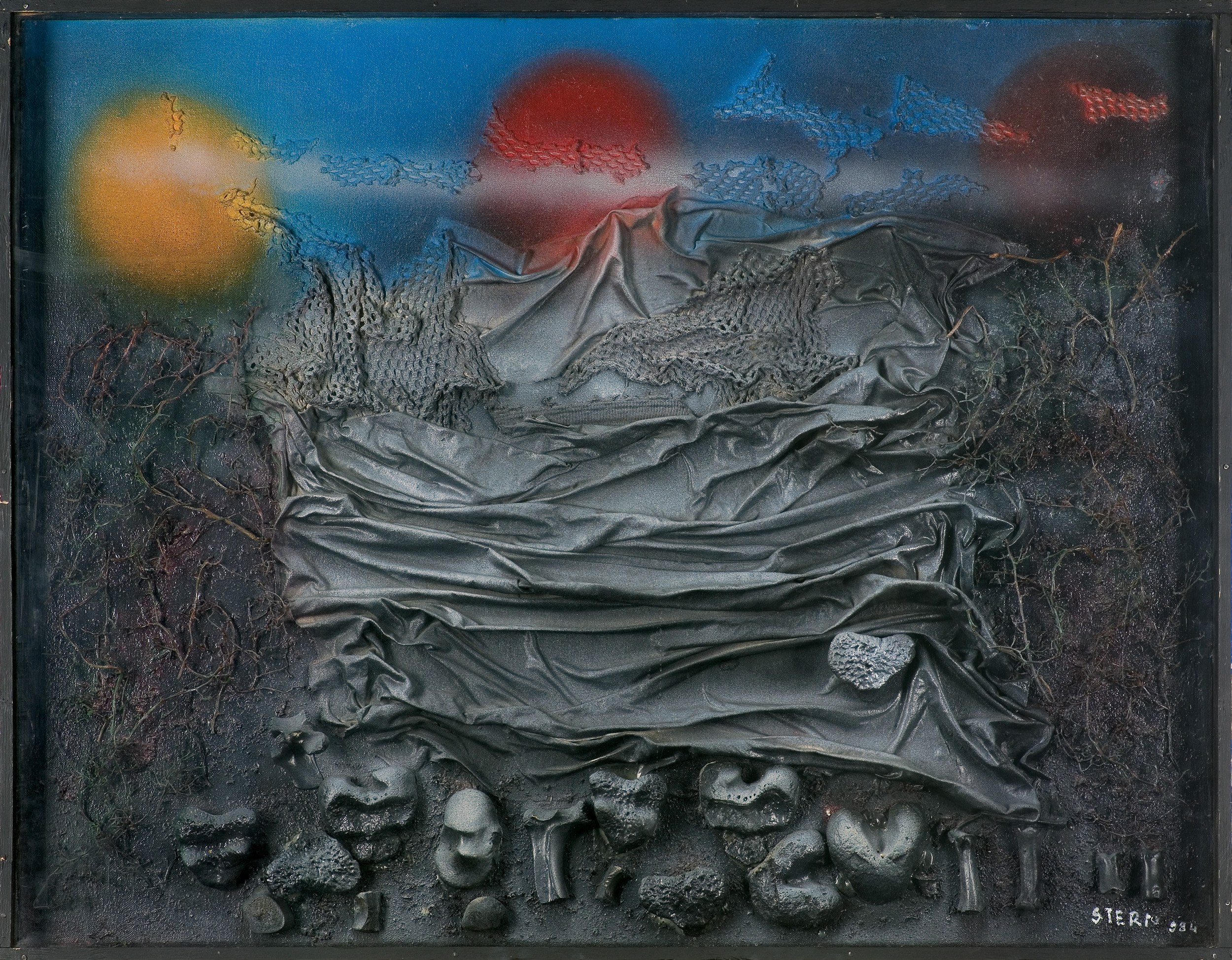
70,5 x 90,5 cm - oil, collage, canvas
70.5 x 90.5 cm (72.5 x 92.5 cm with display case)
sign. p.d.: STERN 984
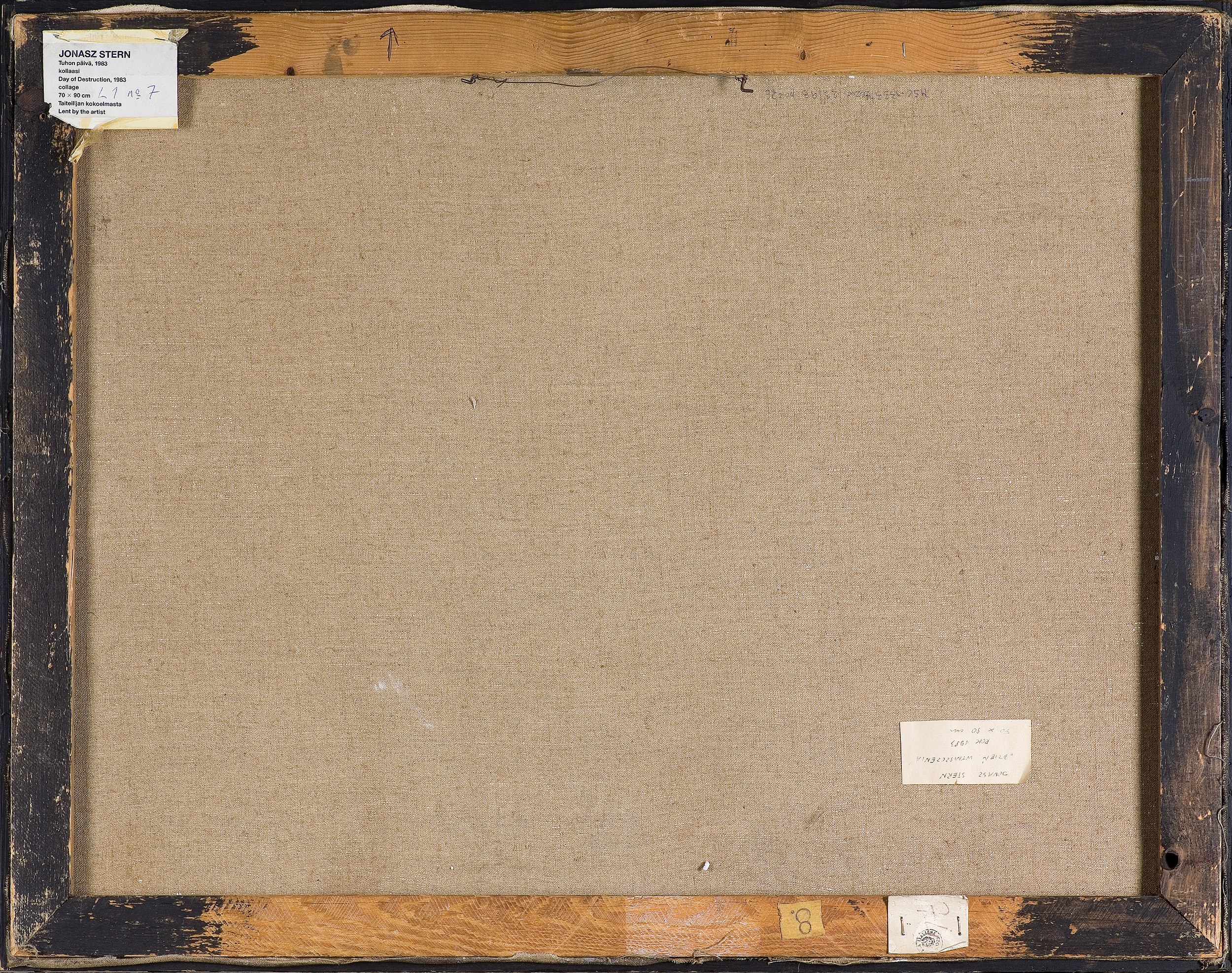
on the reverse p.d. sticker: JONASZ STERN | "DAY OF DISCOVERY" | YEAR 1983 | 70 x 90 cm, p.g. long. number of permission to export abroad.
on g. loom strip sticker in Finnish and English with details of painting and dlg.: L1 no. 7.
on the d. loom strip a pinned piece of paper with the stamp of the Italian customs office, no: 74 and a slice with no: 8.
The painting is accompanied by an expert report by Dr. Maria Anna Potocka.
The painting exhibited and described:
- Jonasz Stern 1904-1988. works known and unknown, Gallery of Sculpture, Warsaw, XII 1996 - I 1997, p. nlb, item 10 (with dimensions 72 x 92);
- Jonasz Stern 1904-1988, Witches' Tower BWA Gallery, Slupsk, III - IV 1988, p. nlb., item 26 (with dimensions 70 x 80 cm);
- Jonasz Stern paintings 1964-1988, District Museum in Nowy Sącz Dawna Synagoga Art Gallery, IX - XI 1988, p. nlb., item 30;
- Jonasz Stern. Jubilee Exhibition, Palace of Art, Cracow, I - II 1985, p. 51, item 93.
Jonasz Stern's experiences during the war, when the artist found himself on the brink of life and death, found echoes in his work. Returning to the themes of the Holocaust, had for him a dimension of moral responsibility, to which he felt as a participant and witness of those events. The fullest, most individual expression was found in Stern's works created since the 1960s. Motifs that he had previously expressed more literally began to take the form of collage, especially with the use of animal bones. Such compositions became a distinctive, recognizable mark of this artist's work, and the work presented at our auction is an excellent example of the full, most developed phase in the entirety of Jonah Stern's artistic achievements.
This is what Maria Anna Potocka wrote about this outstanding and very intense painting in an expert opinion accompanying the work: "The painting "Day of Extinction" is an elaborate and symbolically dense composition, in which the artist combined animal bones, "skeletons" of plants, netting, crumpled, wind-blown fabric - a symbol of tallit - with scattered dust. He combined these materially very different elements into a unity with a color balancing between black and gray. He topped the painting with symbols of the sun and blue sky, expressing hope that above the devastated world light and joy can return. (...).
♣ a fee will be added to the auctioned price, in addition to other costs, based on the right of the artist and his heirs to receive remuneration in accordance with the Law of February 4, 1994 - on Copyright and Related Rights (droit de suite).
Jonasz Stern took his first painting lessons privately in Lviv in 1922. From 1928 he studied at the
at the Ludwika Mehoffer Free School of Painting in Krakow, and then studied at the Academy of Fine Arts there from 1929-1935. During his studies, the Cracow Group (known as the "first" Group, as opposed to the post-war Group, still active today, to which Stern also belonged) was formed in Stern's closest circle and with his participation. The artist was repressed for his membership and activity in the Polish Communist Party, and in 1938 was sent to the camp in Bereza Kartuska. During the Soviet occupation in Lviv, where he found himself at the beginning of the war, he joined the artistic life of Western Ukraine, participated in exhibitions, etc. Under the German occupation he stayed in the ghetto. Accidentally rescued during a shooting, he escaped to Hungary, where he lived to see the end of the war. After returning to Cracow, he joined the Group of Young Visual Artists centered around Tadeusz Kantor. From 1954 to 1974 he was a teacher at the Academy of Fine Arts in Cracow. In the initial, pre-war phase of his work, he was influenced by avant-garde trends in art, mainly cubism and expressionism. In the 1940s he created his first abstract compositions, sometimes using the technique of decalcomania, which brought the expression of his works closer to surrealism. Still, he did not shy away from geometric abstraction. During the period of Socialist Realism, like other artists in his circle, he did not join the official art life, conducting his experiments in isolation from the public and critics. After 1956, with the advent of informel art and then matter painting, the form of Stern's painting crystallized as well. He began creating relief structures using fish skeletons, skins, bones and other organic waste. He arranged them into fantastic "landscapes", which he covered with paint and enclosed in showcases, sometimes specially designed. This type of work became a universally recognizable hallmark of Stern's art, including when, instead of fish waste, he began to enclose photographs, textiles, sometimes overburnt, and other symbolic objects in display cases, relating to the dramatic past - his own and that of the Jewish people. He would label his works with ambiguous or metaphorical titles that reinforced their meaning.











Recentemente visualizados
Efetue login para ver a lista de itens
Preferidos
Efetue login para ver a lista de itens