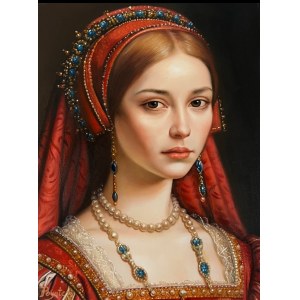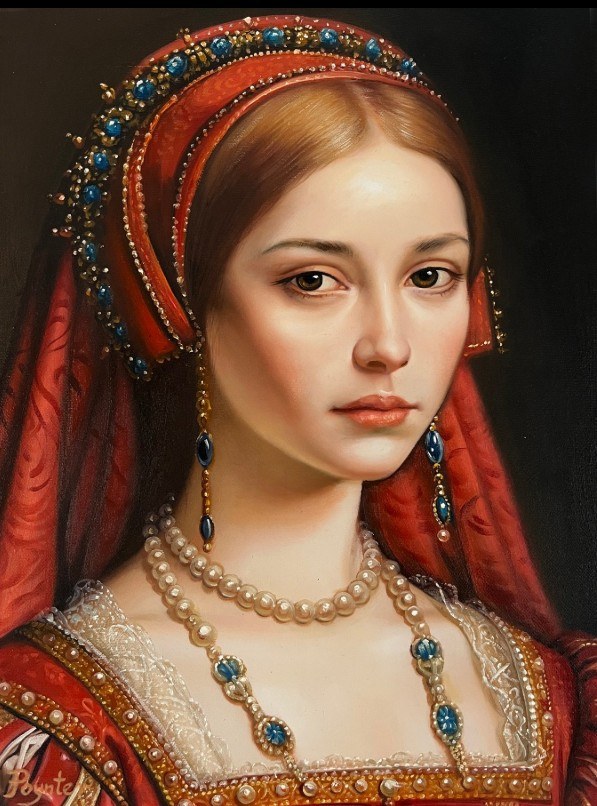
Oil on canvas, 40 x 30 cm, 2026.
Signed on the reverse
Leon Poynter (b. 1970)
He is a contemporary British realist painter whose work consciously draws on the centuries-old tradition of European portraiture. The artist comes from a family with deep roots in art and creative pursuits, and he views his own painting practice as a continuation of the classical craft passed down through successive generations.
In an era dominated by the speed of the digital image and the search for ever-newer means of expression, Poynter turns to the craft of the past. He is primarily interested in precise drawing, carefully constructed form, subtle modeling with light, and a multi-layered oil painting technique. He uses transparent glazes and gentle tonal transitions to create a sense of depth, the natural softness of skin, and the noble luster of fabrics and jewelry.
Portraiture holds a special place in his work. Poynter does not limit himself to reproducing the model’s physical likeness. He is interested in the human presence, hidden emotion, and the untold story that can be read in a gesture, a glance, and the way a figure is set against a dark background. The subjects of his compositions often assume a dignified, almost ceremonial posture, and their costumes evoke the atmosphere of Renaissance and Baroque courts.
The artist draws on the achievements of the old masters of European painting, including Rembrandt, Vermeer, Caravaggio, Velázquez, Rubens, van Dyck, Goya, Frans Hals, and John Singer Sargent. Contemporary classical realism, represented by artists such as Roberto Ferri, Odd Nerdrum, and Jeremy Lipking, is also an important point of reference for him.
Poynter remains, however, a contemporary artist. He uses historical costumes, traditional techniques, and the aesthetics of the old masters to create new, imagined characters. His portraits are not reconstructions of specific museum works but independent compositions in which the past becomes a language for telling stories of beauty, dignity, and human inner strength.
The artist’s works are held in private collections in the United Kingdom, the United States, China, France, Germany, Switzerland, Japan, Italy, South Korea, and the Netherlands, among other countries. The artist’s profile and basic information about his practice are also available on his official website and on Saatchi Art.
Description of the work
“Isadora—A Gift Shaped by the Ancient Gods”
The presented painting is an intimate portrait of a young woman depicted in a rich, historicizing court costume. The composition was constructed in the spirit of classical Renaissance and Baroque painting; however, the figure depicted is not the likeness of a specific ruler. Isadora is a timeless personification of beauty, nobility, and inner strength, created by the artist.
The model is depicted in a half-length pose, with her face turned almost directly toward the viewer. Her calm, focused gaze establishes direct contact with the viewer. Yet it is neither provocative nor theatrical—it exudes restraint, self-assurance, and a subtle melancholy. Her gently pursed lips and composed posture lend the portrait psychological depth.
Poynter models the subject’s face with great precision. Soft light falling from the left illuminates her forehead, cheeks, bridge of the nose, and neck, while the opposite side of her face gently fades into semi-shadow. The chiaroscuro used here is not abrupt or dramatic. It serves primarily to bring out the natural plasticity of her features and emphasize the young woman’s delicacy.
The depiction of the skin is particularly noteworthy. The fair complexion is built up from many subtle tonal transitions—from cool half-shadows, through creamy highlights, to the warm blush visible on the cheeks and lips. The smoothly rendered surface of the face contrasts with the rich texture of the costume, jewelry, and headdress.
Isadora’s reddish-chestnut hair has been carefully parted and is partially concealed beneath a red, gem-encrusted cap. The design of the headdress draws on the ceremonial fashion of European courts at the turn of the 15th and 16th centuries. Ornamentation featuring pearls, gold beads, and vivid blue gemstones forms a decorative arch encircling the face like a jewel set in gold.
The deep reds of the veil and costume symbolize strength, passion, high status, and vitality. Contrasted with them, the cool blues of the gemstones introduce a sense of calm and spiritual purity. Pearls, traditionally associated with nobility, innocence, and perfection, emphasize the ceremonial nature of the image.
The jewelry is particularly exquisitely crafted. The long earrings, several strands of pearls, and a necklace with blue gemstones are not merely decorative. They establish the rhythm of the composition and guide the eye from the face toward the richly decorated gown. Subtle glints of light on the pearls and gold elements enhance the impression of materiality and luxury.
The heroine’s outfit is depicted with extraordinary attention to detail. The light-colored, embroidered fabric of the dress contrasts with the red sections of the cloak and the dark background. The ornaments, pearls, and jeweled appliqués are rendered with small, precise brushstrokes. The artist differentiates the textures of the materials: the smoothness of the leather, the softness of the veil, the luster of the pearls, the weight of the gold ornaments, and the delicacy of the lace neckline.
The dark, almost entirely neutral background strips the scene of any specific place or time. As a result, all attention is focused on the face and the opulence of the attire. The figure seems to emerge from the darkness, which is a clear reference to the portrait tradition of the Old Masters and the chiaroscuro technique.
The title “A Gift Shaped by the Ancient Gods” lends the work an additional, almost mythological dimension. Isadora appears as the embodiment of ideal beauty—not only physical beauty, but also that which stems from harmony, dignity, and inner peace. She is neither a passive nor a purely decorative figure. Her direct gaze suggests self-awareness and independence.
The painting can also be interpreted as a contemporary reflection on the canon of female beauty. Poynter draws on the historical form of the representative portrait, but instead of a specific queen or aristocrat, he depicts an imaginary figure. In this way, Isadora becomes a universal symbol of femininity that transcends the boundaries of a single era.
Technique and Quality of Execution
The work was hand-painted with oil paints on high-quality linen canvas. Linen, thanks to its finer and more regular weave than typical cotton canvas, allows for precise rendering of facial features, jewelry, and costume ornaments.
The painting is distinguished by its layered approach to building color. Delicate glazes lend the skin depth and luminosity, while bolder brushstrokes applied to the jewels and decorations create a three-dimensional effect. The finest highlights have been arranged so that the crown, pearls, and gemstones appear to truly reflect the falling light.
The small 30 × 40 cm format enhances the intimate nature of the depiction and invites the viewer to observe the work up close. Despite its relatively small size, the composition retains the grandeur and richness characteristic of much larger court portraits.