


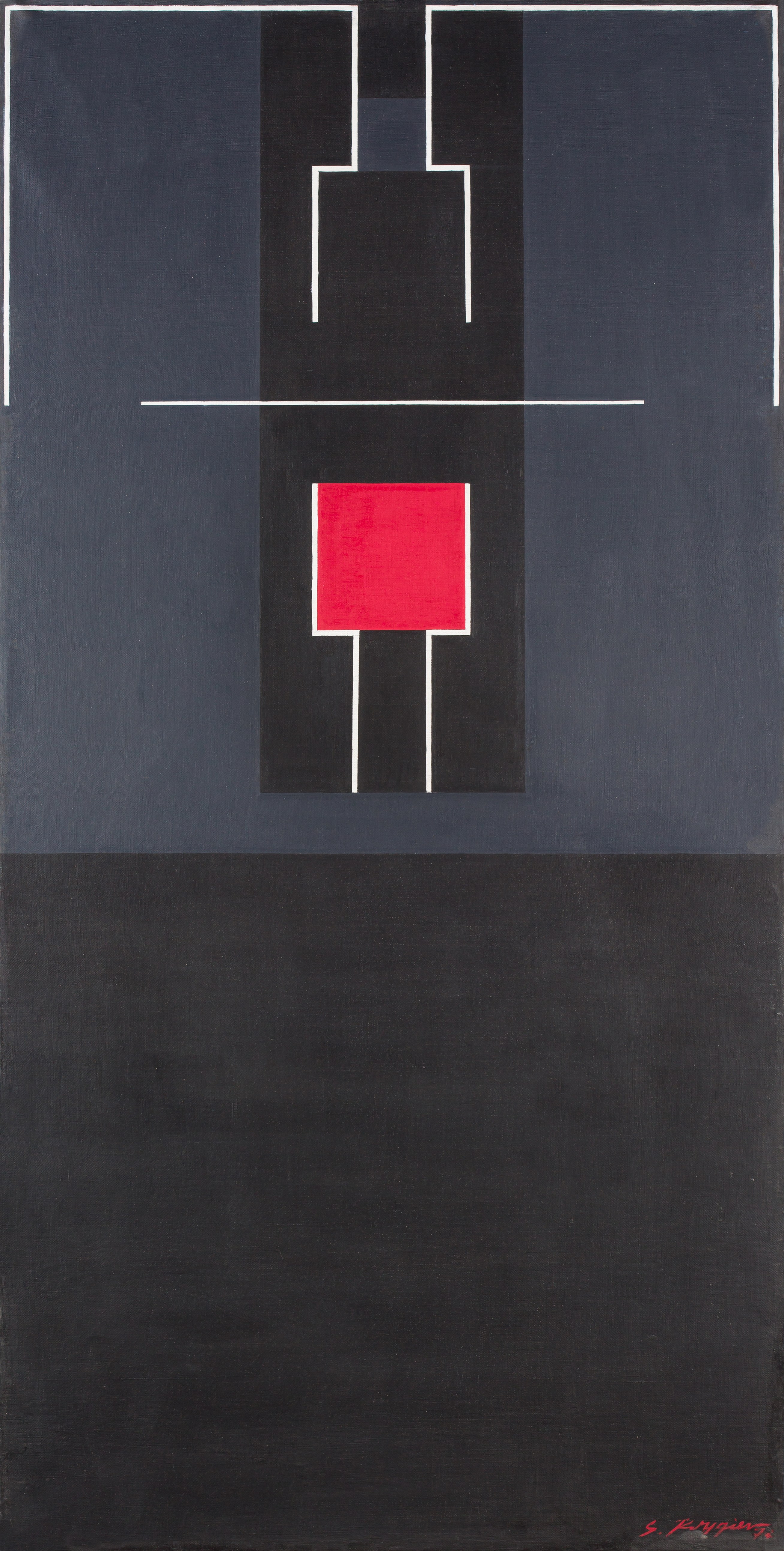


oil, canvas, 120 x 60 cm signed and dated p.d.: S. Krygier / 77 dated and described on the reverse: "CONSTUING SPACE / II" 134. 120 x 60 - 1977
Exhibited:
Stefan Krygier, Painting Graphics. On the 100th Anniversary of the Birth of Wladyslaw Strzeminski, PWSSP in Lodz, November - December 1993;
Stefan Krygier 1923 -1997 Museum of the History of the City of Lodz / now Museum of the City of Lodz/ , November - December 1999;
Zwischen Schwarz und Weiss, Polnisches Kulturinstitut Berlin, Galerie KIK, Berlin, October-November 2000;
Stefan Krygier, Atlas Sztuki, Lodz, 2011;
The Pseudogroups of Stefan Krygier, Green Point Projects, New York, May-June 2018.
Reproduced: The Pseudogroups of Stefan Krygier [solo exhibition catalog] Green Point Projects, New York, Warsaw 2018, p. 65.
Stefan Krygier (1923 - 1997) One of the most important artists of the Polish postwar avant-garde. Graduated from the State Higher School of Fine Arts in Lodz, where he studied from 1945 to 1950 under Stefan Wegner (Department of Painting) and Władysław Strzemiński (Department of Spatial Art). In 1963, he received a diploma in architecture from the Warsaw University of Technology. In the late 1940s, Krygier joined the Club of Young Artists and Scientists in Warsaw, then co-founded the St-53 art group in Katowice. He was involved in painting, printmaking, activities on the borderline of spatial forms and environment. He also carried out architectural and urban planning projects. He taught practical classes and art theory at his alma mater in Lodz from 1957 until the end of his life. Since his studies, he strengthened his acquaintance with Władysław Strzemiński, with whom he published a theoretical work, "Seeing the Gothic." They also collaborated in projects, as the artist himself wrote, "of an exhibition and interior architecture nature." Krygier supported Strzeminski during his most difficult period, until his death in 1952. Krygier's work was shaped under the influence of such trends as cubism, constructivism and unionism instilled in young PWSSP students by Strzeminski. With each successive decade, Krygier explored new techniques and forms of artistic expression. Paintings from the 1950s are inspired by the art of Egypt and Greece. The 1960s saw matter painting, wood sculpture and printmaking. In the 1970s, the artist created oil paintings referring to Constructivism. Later in the 1980s and 1990s he engaged in simultaneous painting. Krygier, with his broad interests - artistic, theoretical and technical - left behind a body of work that is one of the most interesting phenomena in Polish postwar art. Continuing the tradition of the Lodz avant-garde, he skillfully combined the heritage of Polish and world art with his own theories on the physical and metaphysical limits of the image. Krygier's works are in many museums and private collections in Poland and around the world.







