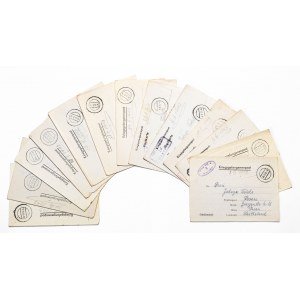
Oflag VII A Murnau - a German prisoner of war camp(Oflag) for Polish officers during World War II, located in the Bavarian town of Murnau am Staffelsee.
The camp was used for the barracks[1] of an armored battalion built in 1939 (for about 600 soldiers), still unfinished when the first batch of prisoners arrived, located 2 km from Murnau. Their adaptation for camp purposes continued virtually throughout the captivity. As the numbers in the camp increased, the attics and cellars in the residential buildings and the garages were used to house the prisoners one by one, with gradual adaptation for housing. The cramped conditions bothered all the prisoners, for example, the generals were housed 5-6 to a room each. Oflag VII A Murnau was described by the Germans as a model camp(Musterlager)[2].
The area of the camp was about 77 hectares, housing about 5,000 people, which means that each prisoner of war had a space of about 2 m²[2]. The initial size of the camp was about 700-800 prisoners of war, including 5 generals(Emil Krukowicz-Przedrzymirski, Jan Kruszewski, Bernard Mond, Tadeusz Piskor and Antoni Szylling). In the following months it increased rapidly to 2,000, in September 1942 it was over 4,000, and on April 29, 1945 - 5457 (including 5114 Poles). Several hundred cadets were in the camp only in the first months, after which they were deported. On March 22, 1945, 381 more POWs evacuated from Oflag II C Woldenberg arrived.
At the end of April 1945, in the face of approaching Allied troops, German oflag commander Petri handed over authority over the camp to General Rommel, after which he was dismissed from the camp[3]. On April 29, 1945, the camp was liberated by one of the units of the American 12th Armored Division of Maj. Gen. Roderick R. Allen, temporarily subordinated to Gen. George Patton's 3rd Army. The camp's commander, Capt. Oswald Pohl, who came out in front of the gate with a white flag at the time, intending to surrender the camp to the Americans, was severely wounded by two SS men. Both of them were killed by American soldiers, and one of the Polish prisoners of war, Lt. Alfons Mazurek, was also killed as a result of the shooting[4].