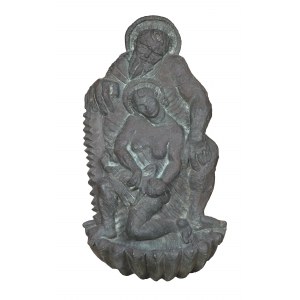
cast bronze, patinated (vert antique patina)
73 cm x cm
Signed l.d.: AZ [tied monogram].
Provenance:
Private collection, Brazil.
Compare with:
- August Zamoyski. Thinking in Stone [exhibition catalog], Adam Mickiewicz Museum of Literature in Warsaw, December 5, 2019 - May 17, 2020, Warsaw 2019, cat. no. 62.
Everything is divine - because God is everywhere. Art consists in discovering Him and communicating this discovery in a divine way.
August Zamoyski (quoted in August Zamoyski..., op. cit., p. 388)
August Zamoyski is one of the most outstanding Polish sculptors of the 20th century. In his youth, the artist succumbed to a fascination with futurism and cubism, while in the interwar period he created a style close to realism, operating with syntheticism and monumental hieratic. However, in the last stage of his work, which falls in the post-war period, expressionist tendencies returned in Zamoyski's sculpture, with the dominance of violent deformations. His works are imbued with a mood of mysticism, with religious themes appearing more and more frequently. Helena Syrkus emphasized that the character of his late period of creativity and the breakthroughs he underwent at the end of his inner life make Zamoyski's artistic path similar to Michelangelo's.
Zamoyski," writes Anna Lipa, " like Rodin and Dunikowski, understood creativity as a mission and priesthood. Since true art, in his opinion, could only be sacred, he saw himself in the role of a priest. In a letter to Władysław Tatarkiewicz dated November 15, 1959, he wrote: "Art is not a profession (...) it is a vocation! - A priesthood! - it is a matter of incredible responsibility, and not any play at beauty!" Thus, he was a continuator of the artistic ideas of Cyprian Kamil Norwid, who in the mid-19th century preached the religious function of art, the priesthood of the artist, as well as the key role of craftsmanship and manual labor in art. " (August Zamoyski..., op. cit., pp. 64-65)
During World War II, August Zamoyski ended up in Brazil - where he lived for the next few years. In 1955 he returned to Europe and settled in France, where he died.
The offered sculpture was created in South America. According to information from the artist found in the catalog of the monographic exhibition (p. 478), the Holy Family was cast in 15 pieces, which were sold in Brazil and France. One of the casts, purchased in 2019 from the artist's legacy, is now in the collection of the National Museum in Warsaw.
August Zamoyski (Jabłoń 1893 - Saint-Clar-de-Riviere 1970) - one of the most outstanding Polish artists of the 20th century, next to Xawery Dunikowski - the most famous Polish sculptor of the first half of the 20th century. He came from an aristocratic family - he was the 12th descendant by marriage of the Ordynat Zamoyski, Stanisław Kostka Zamoyski (1775-1856).
He studied drawing at the Lewin-Funke Schule in Berlin and sculpture at the Kunstgewerbeschule in Munich. After returning to Poland, he co-founded the Polish Expressionists, the first Polish avant-garde group, together with Witkacy, Leon Chwistek and Tytus Czyzewski. From 1923 he stayed mainly in France, and from 1940-1955 he lived in Brazil. There he ran sculpture schools in Rio de Janeiro and Sao Paulo. In 1941, he was appointed professor at the School of Fine Arts in Rio de Janeiro by Brazilian President Getúlio Vargas. In 1955, he settled in France.
He initially created in the currents of Expressionism, Cubism and Futurism, undertaking bold experiments. He was the first Pole who in the first half of the 20th century began to create sculptures similar to the simultaneous dynamism of U. Boccioni. At that time he was also active in the field of theater; together with his wife, dancer Rita Sacchetto, he co-created Futurist performances. Around 1925, the artist broke with the avant-garde and turned to figurative art. He developed his own monumental-classical style, based on realism with a far-reaching synthesis of forms. In the late 1940s, metaphysical-symbolistic content appeared in Zamoyski's work, while the form became expressive and dynamic.