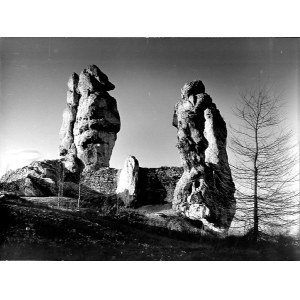
Title: Ogrodzieniec Castle in Podzamcze
Author: Tadeusz Maciejko
Item description:
Notes: The reverse side of the photograph is clean.
Ogrodzieniec Castle (Boner Castle), Gothic-Renaissance, 1530–1545, utilizing the castle walls from the 14th–15th centuries; in ruins; see Atlas of Monuments, p. 437 with an illustration, and more extensively in the Lexicon of Castles 2007, pp. 391–395 with a plan and illustrations, including the fact that the castle gradually fell into ruin following a fire in 1702
About the author: Tadeusz Maciejko (May 14, 1903, Gwoździec, Kolomyia County (Kolomyia District) – June 23, 1979, Gliwice), Polish photographer. Member of the Association of Polish Art Photographers (ZPAF), Silesian Branch in Katowice, since 1953. He had been taking photographs since 1930 and worked as a lab technician at the J. Bujak company in Lviv. From 1935 to 1937, he studied architecture at the Lviv Polytechnic. From 1933, he was a member of the Technical (Technickie) Circle of Amateur Photographers in Lviv, and later of the Lviv Photographic Society (LTF), where he organized nationwide photography exhibitions. In 1936, he left for Berlin to study avant-garde photography and film, which he later introduced to Poland. From 1940, he was a lecturer in photography at the Lviv Polytechnic; furthermore, in 1942, he established the Department of Photography at the former School of Artistic Industry (SPA) in Lviv. In 1945, he settled permanently in Gliwice, where he opened a photography studio called the "Gliwice Photo Agency" (1947–1950), and later worked in Gliwice and Katowice in various capacities, primarily in professions related to photography and film; he retired in 1973. Member of the Gliwice Branch of the Polish Photographic Society (PTF) since 1951. Founding member (1961) and president of the Board of the Gliwice Photographic Society (GTF). He participated in exhibitions of artistic photography from 1934. His pre-war work was among the leading examples of the Polish avant-garde; his post-war work was significantly more traditionalist; see Sobota 2022, mainly pp. 20–21; Fotografowie 1946–2006, pp. 251–252, and other materials. He played an inspiring role in the work of Jerzy Lewczyński (1924–2014). A biography and one of the artist’s photographs in a landmark anthology of Polish photography: Lewczyński 1999 (Jerzy Lewczyński: Anthology of Polish Photography 1839–1989), p. 48
Additional information:
Condition:
Item in good condition, with slightly damaged corners and the right margin of the photograph