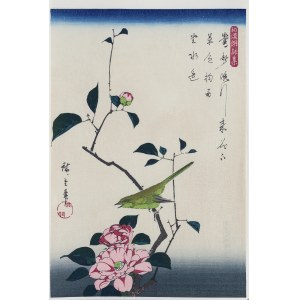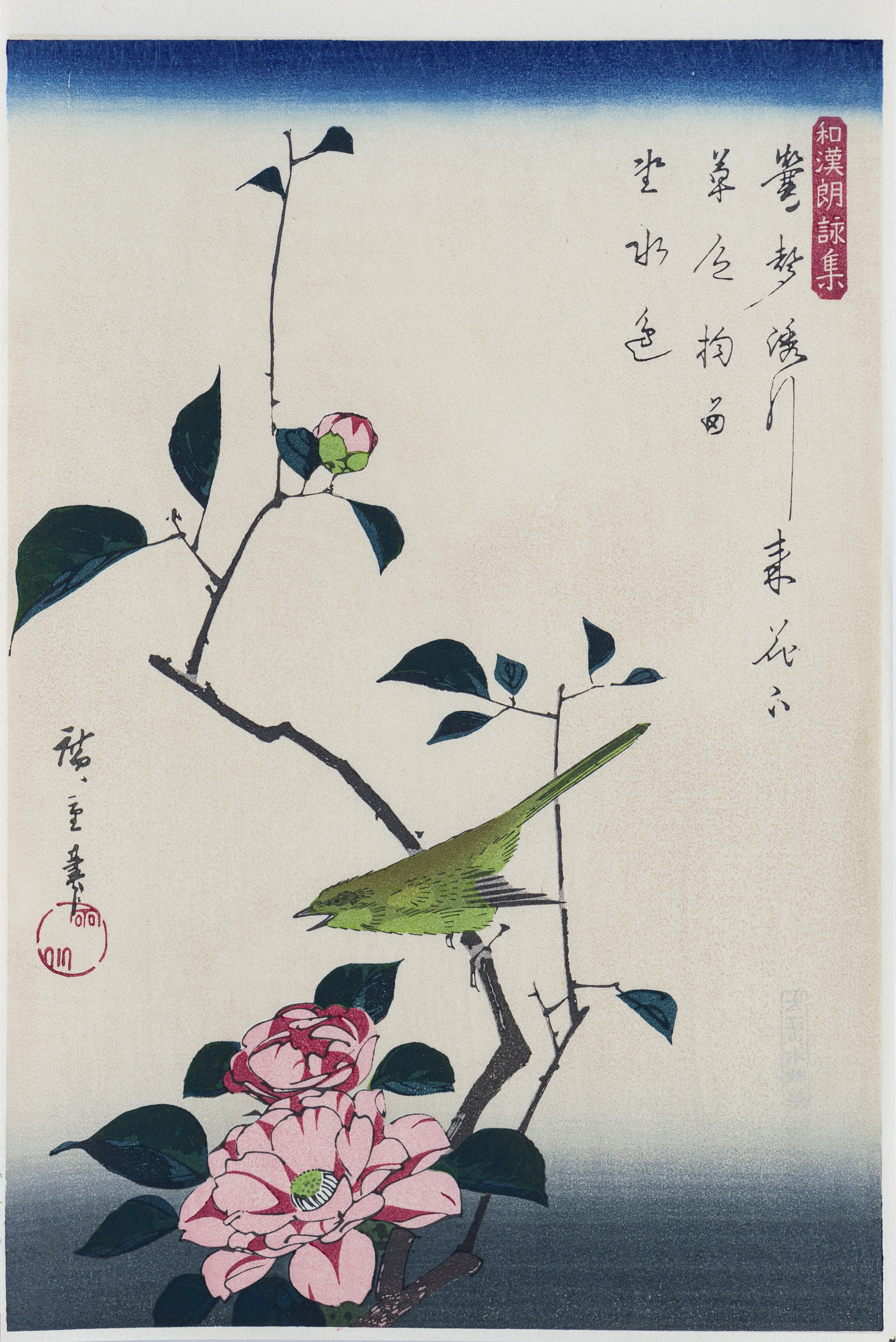
color woodcut, paper, 40x26 cm, signed by the artist; on the reverse, the publisher’s stamp and the artisans’ marks: carved by Hotta, printed by Ogawa
The woodcut depicts a camelliabranch curving in an S-shape from the bottom edge upward. The lower part of the composition is dominated by two blooming, pale pink flowers. Perched on the branch with its beak open is a small Japanese nightingale (uguisu), captured in the act of singing. Its plumage is a vivid olive green, which contrasts sharply with the pastel pink of the flowers. On the right-hand side is a poem taken from the anthology *Wakan Rōeishū*,which loosely translates as:
Drawn by the nightingale’s song,
I took shelter beneath a blossoming tree.
Enchanted by the color of the grass,
I rested by the water’s edge.
This classic design was reproduced by the renowned Tokyo publisher Oedo Mokuhansha during a period of renewed interest in ukiyo-e (the second half of the 20th century). Like many other traditional businesses, the craft of woodblock printing was passed down from generation to generation, and Oedo Mokuhansha was founded by the descendants of an Edo-period publisher. These are beautiful prints of the highest quality and an excellent choice for those seeking high-quality reprints of old woodblock prints.
Hiroshige Andō, also known as Hiroshige Utagawa, is one of Japan’s most famous painters and printmakers. His father, Andō Genuemon, was a low-ranking samurai and an officer in the fire brigade. From the age of sixteen, Hiroshige trained in the studio of Utagawa Toyohira, under whose guidance he developed his skills and talent. The young Hiroshige soaked up the artistic atmosphere while helping out with the day-to-day operations of his father’s fire brigade. It was not until he was 27 that he decided to devote himself entirely to his artistic career. After his teacher’s death in 1822, he was offered the chance to take over his master’s studio, but Hiroshige declined the offer and chose to work independently. Hiroshige’s artistic output has not yet been fully cataloged, but it is estimated that he produced approximately 5,000 works, primarily in the technique of color woodblock printing. He began his career with portraits of beautiful women (bijin-ga) and depictions of kabuki actors (yakusha-e), but after his teacher’s death, he focused primarily on native landscapes. Hiroshige came from a samurai family, yet he identified with the bourgeois culture of Edo. He became famous primarily as the creator of landscape series such as: Fifty-Three Stations on the Tōkaidō (Tōkaidō gojūsan tsugi no uchi), One Hundred Famous Views of Edo (Meisho Edo hyakkei), and Sixty-Nine Stations on the Kisokaidō Road (Kisokaidō rokujūkyū tsugi no uchi). He masterfully depicted landscapes at various times of the year and day, and was interested in weather phenomena. He experimented with effects and composition, employing unconventional foreshortening techniques. A distinctive feature of his work is his depiction of atmospheric phenomena such as snowfall, rain, gales, and storms. He was also fascinated by the phenomenon of shadow and its effects in both landscapes and domestic interiors.