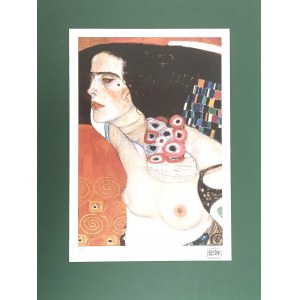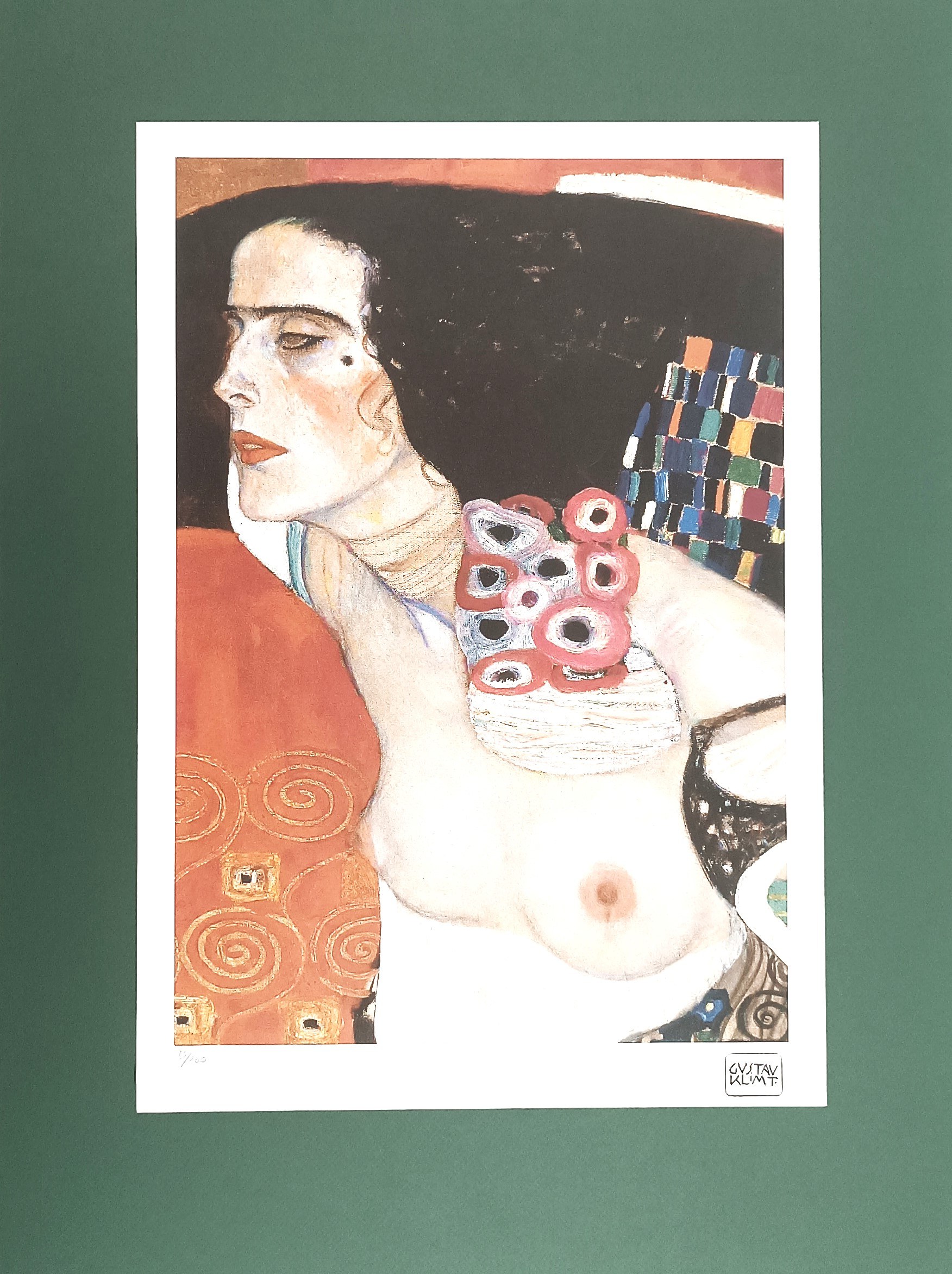
Color lithograph, high-grain veline paper; dimensions: 57 x 39 cm in passe-partout light, 75 x 55 cm in passe-partout frame; signed on the plate under the composition p. d. "Gustav Klimt" , limited edition and numbered in pencil "85/200". Publisher'sdry-erasestamp l.d.: "Trec, Edizioni Pregiate" approved by the Board of Directors of the Museo Osterreichische Galerie Belvedere di Vienna, hologram "verification of authenticity" on the reverse. Original certificate.
Gustav Klimt's Judith II,alsoknown as Salome, is a 1909 work that is a continuation of hisearlier painting Judith I. The painting is the second portrait of Judith painted by Klimt and is considered one of themost importantworks ofVienneseSymbolism.
Judith II, like its predecessor Judith I, depicts the biblical Judith, the heroine who freed the Israelites from the AssyrianinvaderHolofernes byseducingand ultimatelydecapitatinghim.
Judith in Klimt's painting is a woman with a magnetizing gaze that gives the figure an aura of ruthlessconfidenceand dominance. She has a shapely, exposedbreast, whichwasquitea boldmovein Klimt's time.Her expressive, provocative charm and the contrastbetweenherbeauty and thebrutality of her actmake her a symbol of the femme fatale. The woman ispicturedin away thatis both elegant anddisturbing - her sharp facial features, with a stern andcool beauty,expressstrength and a somewhatfrighteningintensity.
The background of the painting, executed in Klimt's characteristic technique, containing golden geometric patterns , gives Judith's figure an almost Byzantine splendor, juxtaposing thepredatory nature of her figure with the decorative richness of her surroundings. Thus Klimt creates astory ofbeauty,power and thedestructiveforce offemininity.
It is believed that themodel for Gustav Klimt's Judith II painting may havebeen Adele Bloch-Bauer, one of his muses and a longtimefriend.Adelewas thewifeof a wealthyVienneseindustrialistand patron of the arts,andtheinspiration for several of his other works, includingthe famous Portrait of Adele Bloch-Bauer I, known as "The Golden Lady."
Both Judith II andthe earlier Judith I caused quite a stir in Klimt's time. The works were perceived as extremely provocative, and their erotic, evenpredatoryovertoneswereshockingto many ofhis contemporaries.KlimtshowedJudith, abiblicalfigure of heroic importance, in adefiant,even sexualmanner, whichcontrastedwith the moral andsocial standards of the time.
Klimt broke convention by depicting Judith not as a modest, dedicated woman whosacrificed herself for the good of her people, but as astrong,sensual femme fatalewho exudedpower andconfidence.
In addition, Klimt had a reputation at the time as a controversial artist. Hisboldapproach tonudityand eroticism -also evident in his other works, such as a series ofpaintings for the University ofVienna,whichwere alsoconsidered scandalous -attractedattention, butalsocriticism. TheViennesepublicwas atfirst notready for such bolddepictions of femalesexualityandindependence,whichdeviatedfrom the traditional and conventionalrolesassigned to women in thesociety of the time.