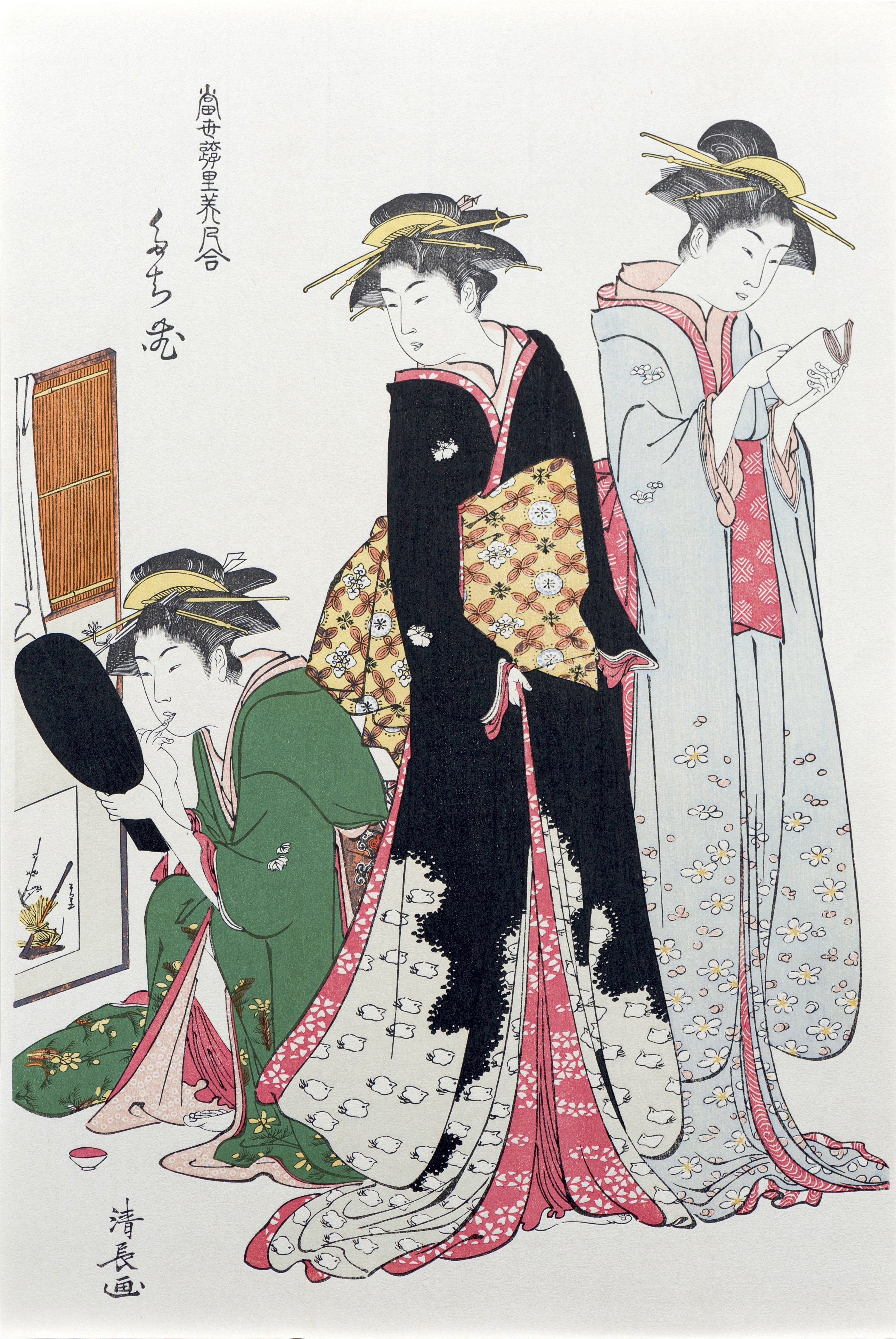
Color woodcut, ink, paper, 39.5x26 cm, publisher's mark on the back
One of the designs in a series comparing beauties from different "houses" in the pleasure districts. This one depicts the geisha of Tachibana during their daily activities. One of them is improving her makeup in front of a mirror. All the beauties are dressed in colorful, patterned kimonos.
Torii Kiyonaga (1752-1815) was a prominent Japanese ukiyo-e artist of the Edo period. He was born in Edo (present-day Tokyo) and became a member of the Torii school, known for its association with kabuki theater and production of plays. Kiyonaga is best known for his bijin-ga prints, depicting elegant and fashionable women of various social classes. His works often featured the latest trends in fashion, hairstyles and accessories. His bijin-ga graphics are characterized by a refined and delicate style and attention to intricate detail and vivid color. He emphasized elegant poses, graceful movements and use of space, with which he influenced later generations of artists. Despite his success during his lifetime, Kiyonagi's popularity declined after his death. His work experienced a renaissance in the late 19th century and in the 20th century, when ukiyo-e woodcuts once again gained interest both in Japan and internationally. Today Torii Kiyonaga is considered one of the masters of ukiyo-e, and his prints are highly regarded for their artistic and historical value.
The ukiyo-e woodcuts have been printed several times since the Edo period, always using the traditional method. The best publishers in Japan followed the same rigorous standards as 19th century publishers. In the 1950s and 1970s, as interest in Edo period woodcuts increased again, the reissue of prints by great masters from the golden age of Ukiyo-e began. Some of the world's finest printmakers and carvers were employed for this purpose. The resulting works are among the highest quality editions ever produced.