Sweden
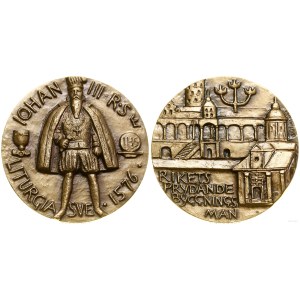
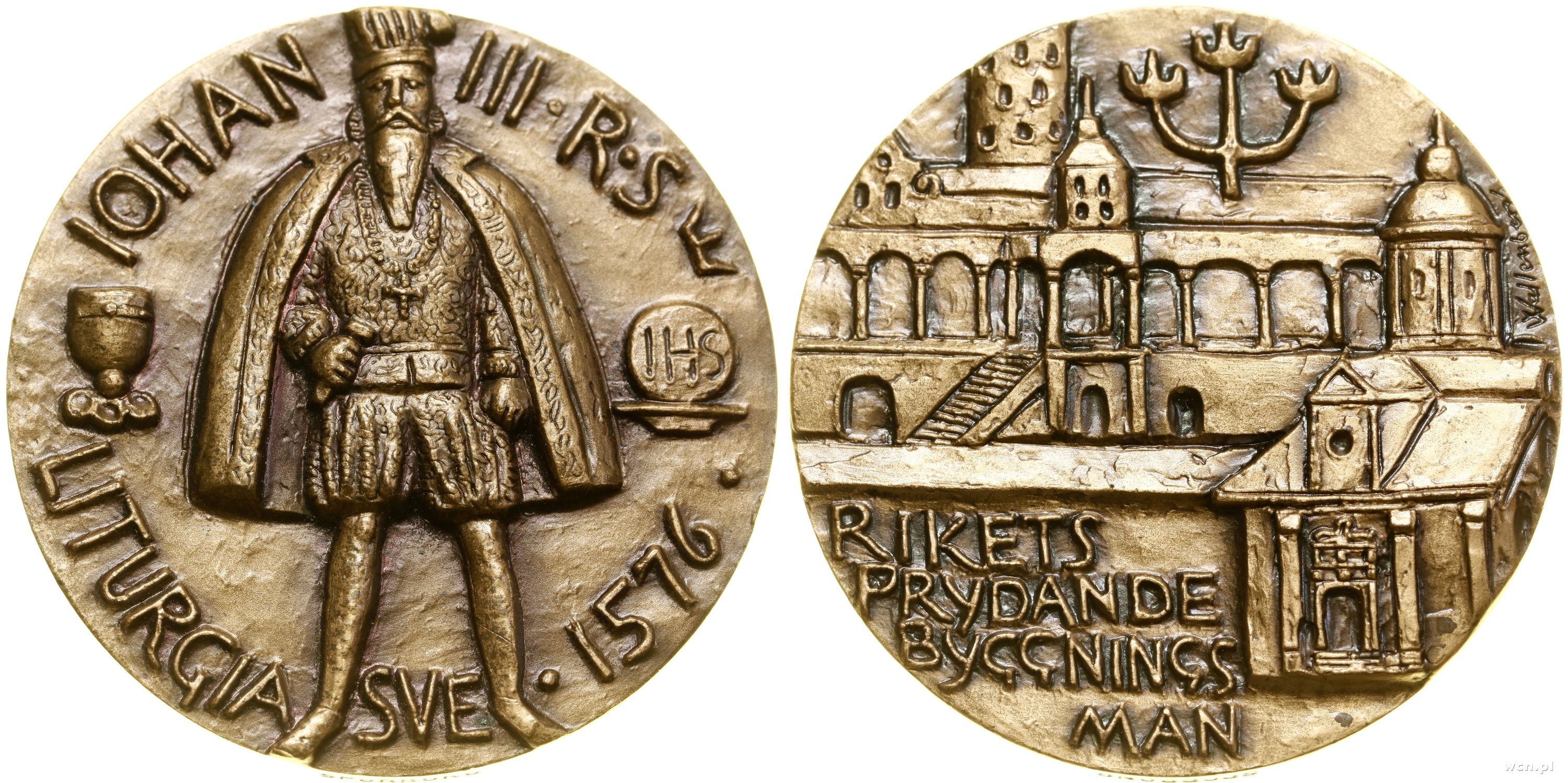
Obverse: A figure standing facing forward, with a chalice and a Host on either side, IOHAN - III • R • S - LITURGIA - SVE - • 1576 •, Reverse: A castle courtyard (?), at the bottom left RIKETS / PRYDANDE / BYGGININGS / MAN, Edge: Stamped SPORRONG and 0478 • 2000
bronze, 40.0 mm, 43.22 g.
Axel Gereon Wallenberg, born May 22, 1898, in Nässjö, and died January 14, 1996, in Danderyd, was a Swedish sculptor, medalist, and draftsman. He created commemorative medals and coins, including those marking the Swedish rescue expedition to Spitsbergen in 1928, the Stockholm Exhibition in 1930 and the 500th anniversary of the Riksdag in 1935, as well as medals commemorating Milles’s 70th birthday and Gustav V’s 90th birthday. One of Wallenberg’s last commissions was a commemorative medal marking the 200th anniversary of friendship between Sweden and the United States in 1976, as well as several royal art medals in 1978, including the one described here.
A royal medal from the series “Sweden and Its Rulers Over 1,000 Years,” designed by Axel Wallenberg. The obverse depicts King John III. Below is the inscription “LITURGIA SVE . 1576” (John III preferred the solemn Roman Catholic Mass over the more austere Swedish Mass. For this reason, he personally wrote a new order of service, the so-called liturgy, which was documented). This event led to a long-lasting and damaging schism with the Church of Sweden. The reverse depicts a view of the old Tre Kronor Castle. The inscriptions “RIKETS,” “PRYDAND,” “BUGGNADS-,” and “MAN” refer to John III’s interest in architecture and castle construction, depicting the courtyard of the old Tre Kronor Castle.
John III, born on December 20, 1537, at Stegeborg Castle, was the son of Gustav Vasa, brother of Charles IX, and half-brother of Eric XIV. He was married to the Polish princess Catherine Jagiellon (1526–1583) from October 4, 1562 (which led to the Vasa dynasty also became rulers of the Polish-Lithuanian Commonwealth), with whom he had Sigismund (later King of Poland and Sweden) and a daughter, Anna Vasa, as well as with Gunilla Johansdotter (Bielke) (1568–1597) on February 21, 1585. In the spring of 1592, he fell ill with a fever. He died six months later, on November 17, 1592, at Tre Kronor Castle in Stockholm, leaving his kingdom weakened by external and internal unrest. He was succeeded by his son Sigismund. A medal historically associated with Poland.