


Pinchus Kremegne (1890-1981)
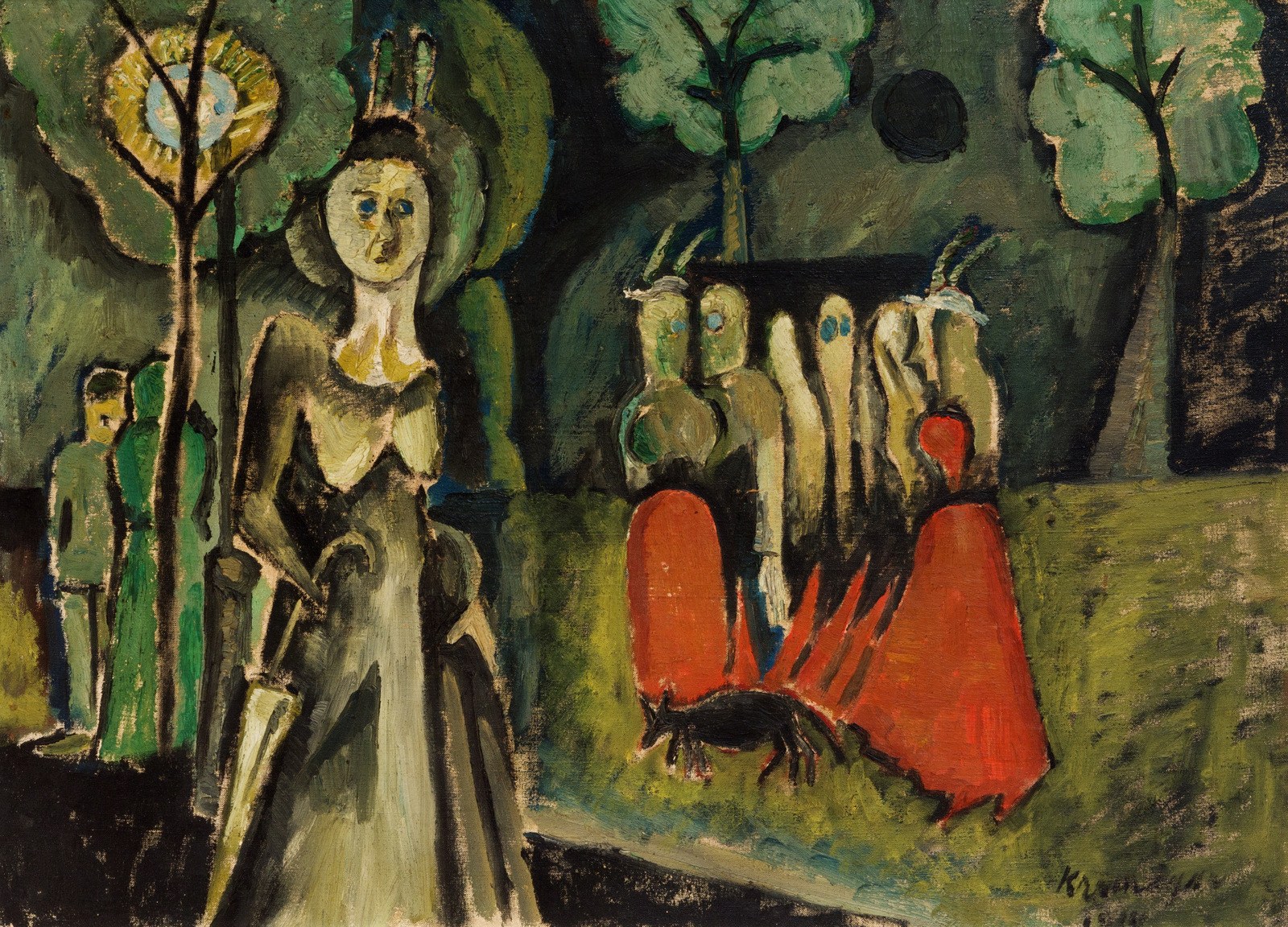
A character in the forest
1914, drb., al., 54 x 73
Sign. AD: Kremegne / 1914
MYSTERIOUS PAINTING
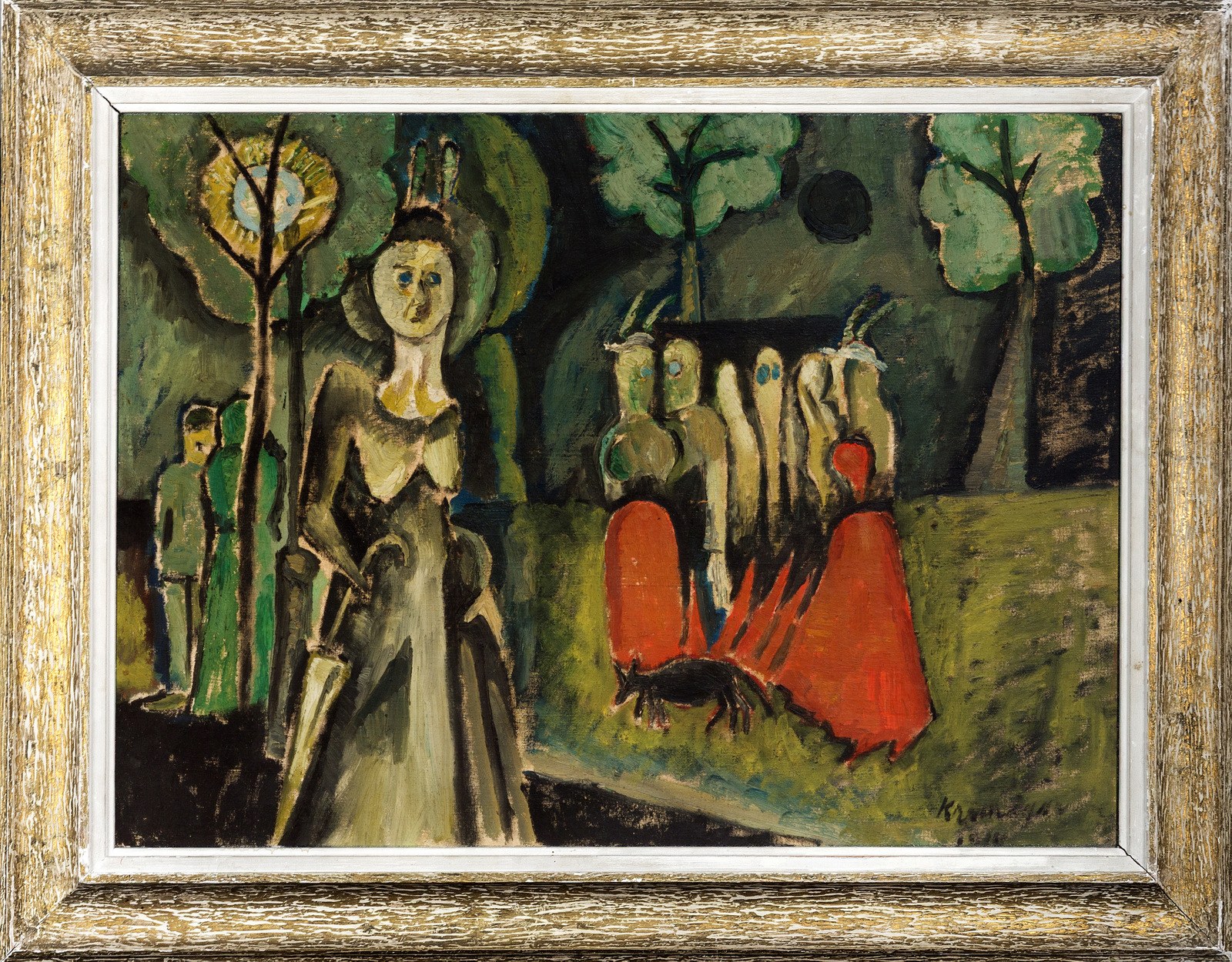
Pinchus Krémègne was a Litvak painter and sculptor, a student of the Vilnius School of Drawing and one of the most famous representatives of the so-called Paris School. "The Figure in the Forest" is a rare and very interesting example of early painting. Unlike the landscapes, portraits and still lifes that would later make the artist famous, it is a fantastic composition with a mystical mood, allegorical character and genre uncertainty. The painting also reflects Krémègneʼs early explorations in painting, as he began his career in sculpture. In the foreground of the landscape, the figure of a horned woman standing up emerges. On closer inspection, the woman is accompanied by a ghostly creature, a shadow, with luminous eyeholes, which casts horn-like lights over the woman's head. Or maybe the shadow does not exist, maybe it has just appeared because it has grown into the green tones of the landscape? Who is the character in this painting - the woman or her shadow? The woman's nervous facial expression, her dry figure and the tight folds of her drapery create a chilling tension. Equally mysterious is the group of horned women on the right, a little way off, with a dog wriggling. Their red skirts and rhythmically flowing dark outlines betray the Art Nouveau style that was vibrant in the early decades of the 20th century. More than his other paintings, this painting by Krémègne is linked to the Art Nouveau movement, which is characterised by its visionary quality, its incompleteness, its sinuous lines and its attempt to understand the mysterious nature of women. A more realistic pair of people emerges on the left, but the sun and dark moon in one of the paintings make it impossible to shake the idea that the subtext of the work is more complex than it might seem. The painting is characterised by a decorative totality, ignoring spatial perspective - the silhouettes of the trees are arranged in a solid band, softened by the post-impressionist modelling, and the structure is enlivened by the slightly diagonal direction of the path.
What did the artist want to say and what inspired him? Perhaps the artist had seen his friend Marc Chagall's paintings of domesticated animals from his native shtetl, created a few years earlier? Or was he influenced by the work of Francisco Goyaʼs popular among the modernists of the period, especially his visionary cycle of six paintings (1797-1798), painted for the Osun princes, depicting witches in strange headdresses and a rhinoceros interposed among them? The artist's work did not represent a single artistic movement, but a fusion of Expressionism, Post-Impressionism, Symbolism and Surrealism. Today, it is difficult to determine what gave rise to this painting, but what is more important is that, thanks to his extraordinary talent, a work of great lasting value was painted.
Dr. Lijana Natalevičienė












Recentemente visualizados
Efetue login para ver a lista de itens
Preferidos
Efetue login para ver a lista de itens