


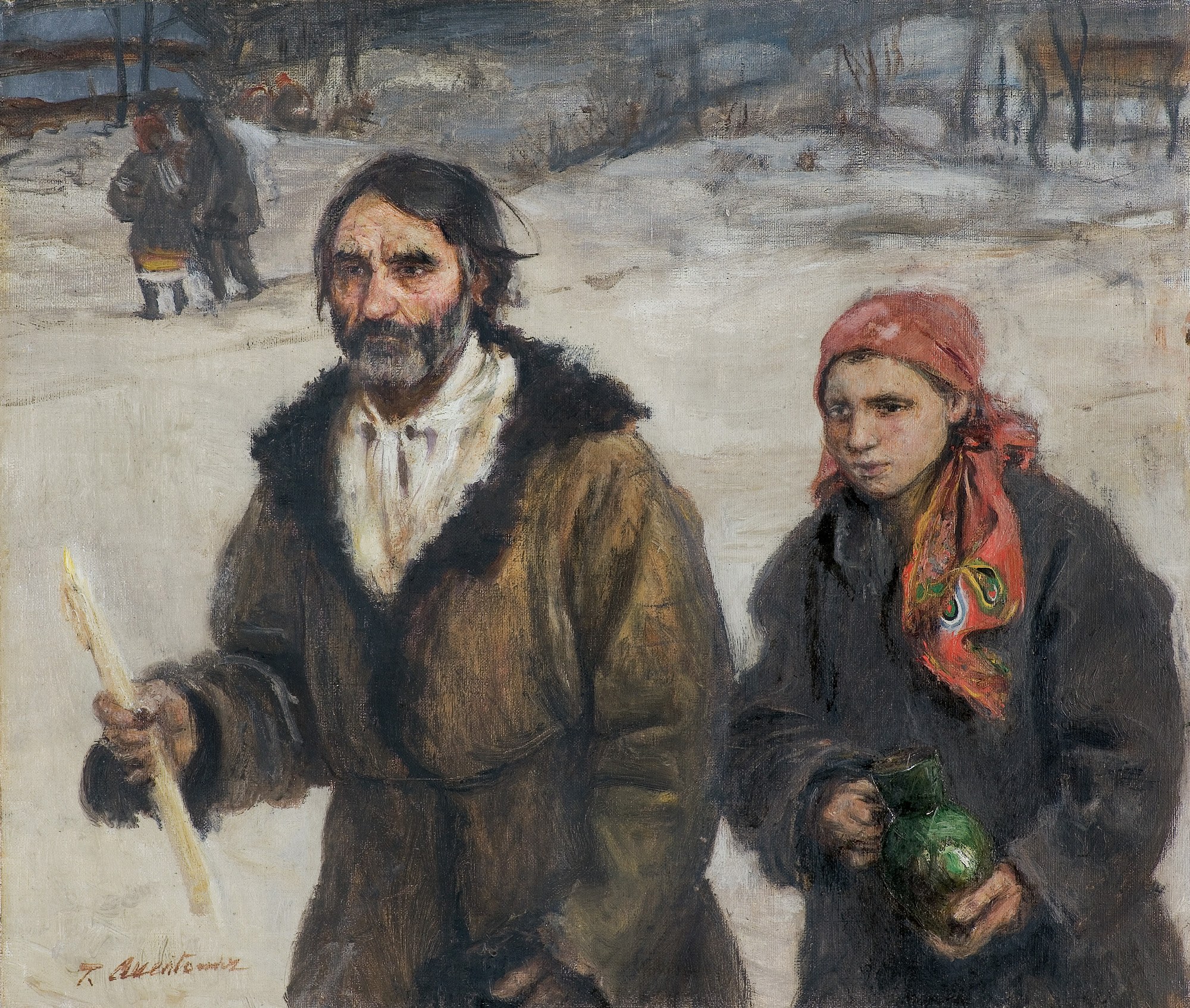
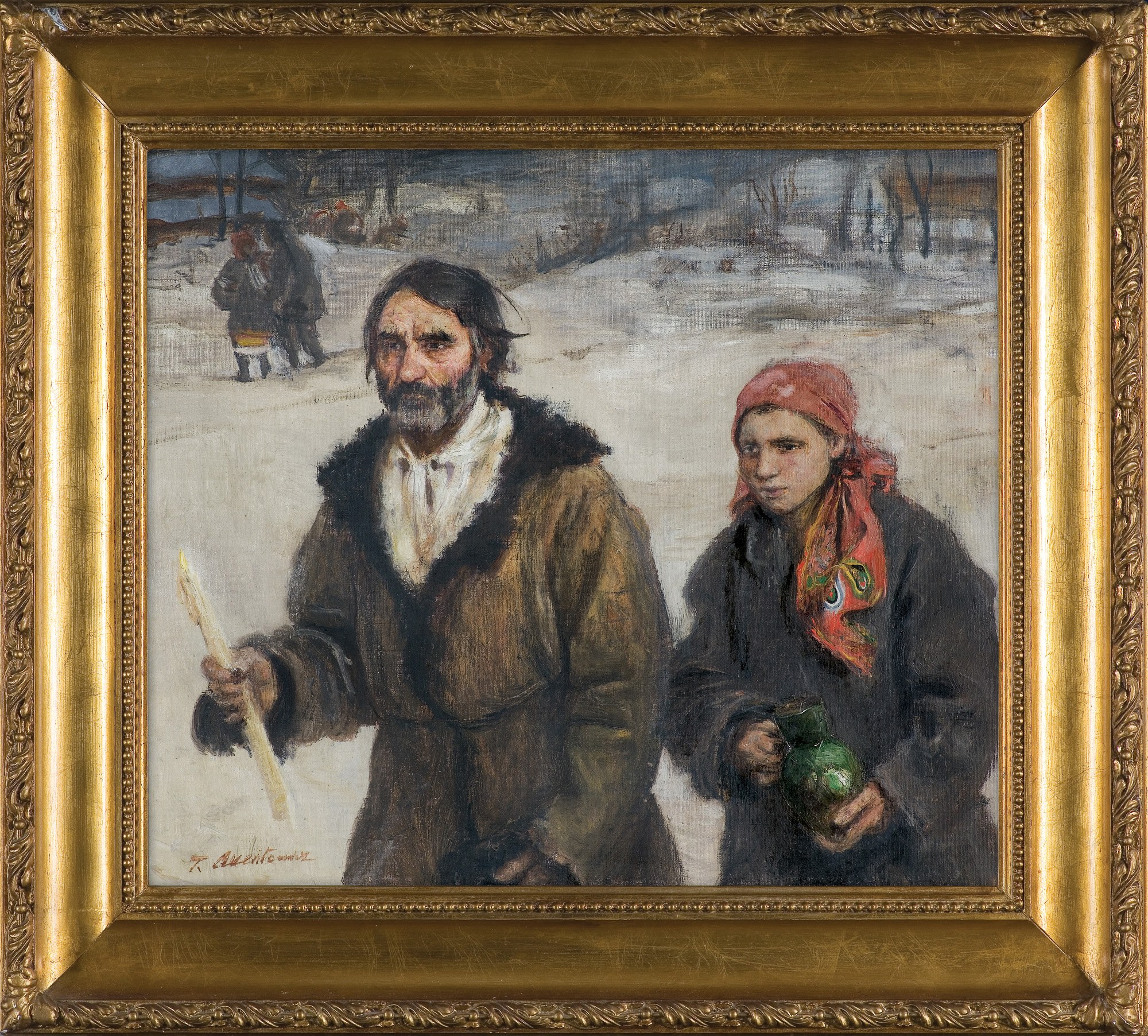
46.7 x 54.6 cm - oil on canvas
signed lower left: T. Axentowicz
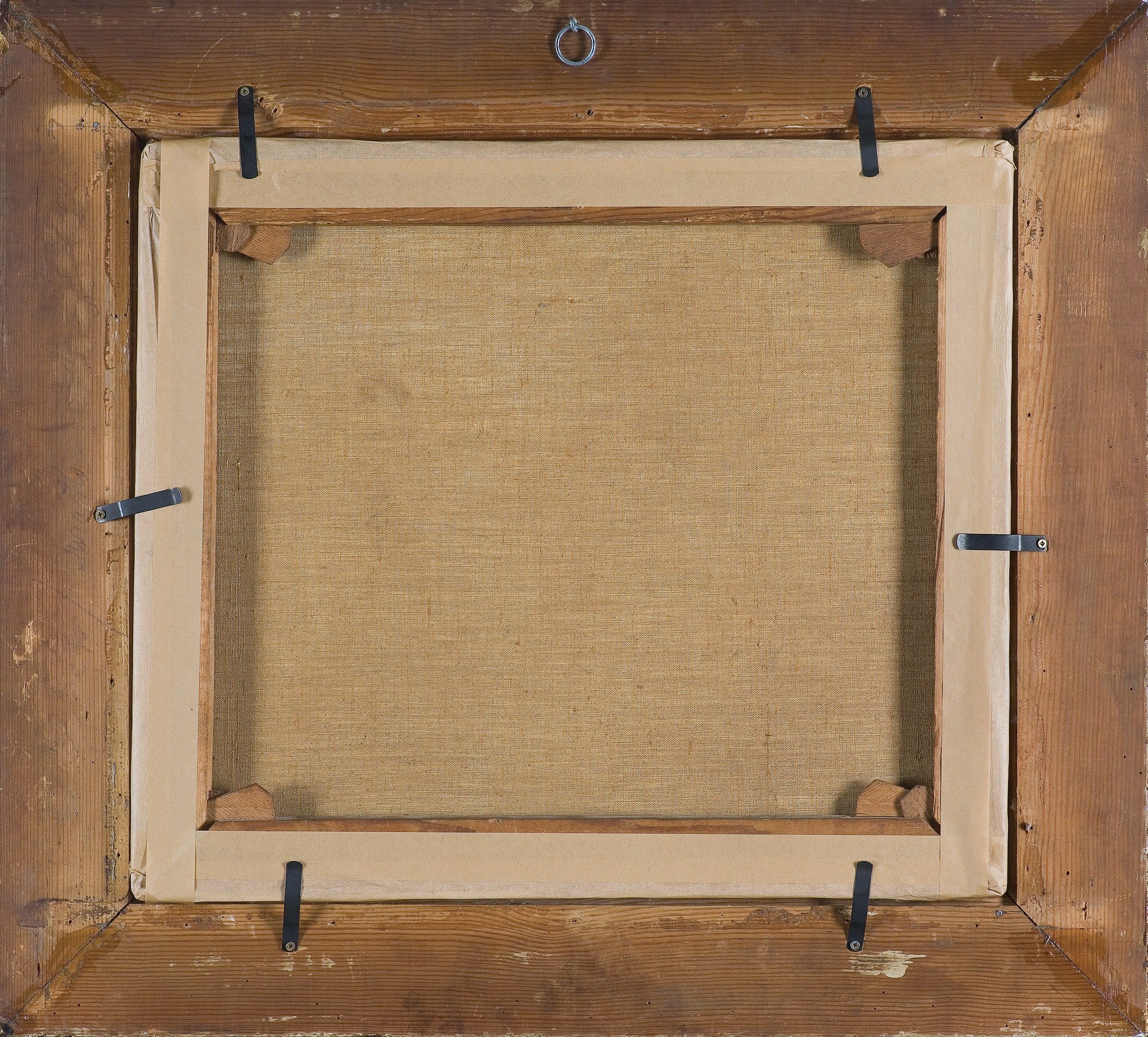
On the reverse, on all the stretcher bars, there are stamps: SKŁAD PAPIERU | R. ALEKSANDROWICZ | KRAKÓW BASZTOWA; additionally, numbers referring to the size of the support—on the left and right stretcher bars, the number (in blue crayon): 46, and on the top and bottom stiles, a red stamp with the number: 54.
Teodor Axentowicz (Brașov, Transylvania, 1859 – Kraków, 1938)—painter, pastel artist, and lithographer—was one of the most famous and highly regarded Polish painters. He studied at the Academy of Fine Arts in Munich under Gabriel Hackl, Alexander Wagner, and Gyula Benczúr. He continued his studies in Paris, where he subsequently lived for over a dozen years. He participated in the Paris Salons; in 1890, he was admitted to the Société Nationale des Beaux-Arts. During this time, he also traveled to London on numerous occasions. In 1895, he returned to Poland and settled permanently in Kraków, having been appointed professor at the local School of Fine Arts (which became the Academy in 1900). He taught at this institution continuously until 1934, serving twice as rector (1910–11 and 1927–28). He was one of the founding members of the Polish Artists’ Society “Sztuka,” a member of the Vienna “Secession,” and a contributor to its journal “Ver Sacrum.” He achieved particular success with his idealized depictions of refined ladies and his charming portraits of children. He also painted genre scenes; he was one of the first painters to depict the Hutsul region and the Hutsuls. He created historical paintings and symbolic compositions related to the passage of time, transience, and old age. During his early Munich period, his works were imbued with the spirit of academic realism; his later work was influenced by 18th-century English painting and the works of contemporary artists—Boldoni, Whistler, and Sargent. His paintings are characterized by their decorative quality, elegance, the freshness of a subtle color palette, and a delicate Art Nouveau style. Initially, he painted in oils and watercolors, and after 1890, primarily using the pastel technique, which he had mastered to perfection. He worked as an illustrator and lithographer and designed posters for “Sztuka” exhibitions.













Recentemente visualizados
Efetue login para ver a lista de itens
Preferidos
Efetue login para ver a lista de itens