


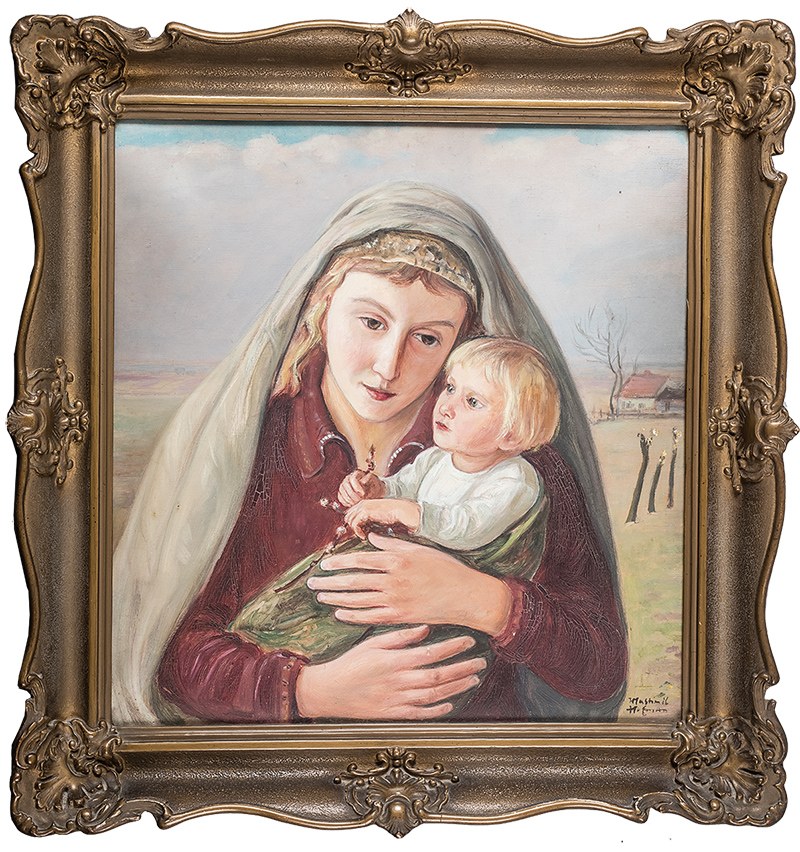
oil, plywood, 55 × 52 cm
Signed p. d.: Wlastimil/Hofmann
The Madonna motif is constantly present in Hofman's work. The first realizations appeared very early, as early as 1904, shortly after the artist graduated from the École des beaux-arts in Paris (B. Czajkowski, Portrait from Memory, Wroclaw 1971, p. 97). These representations are characterized by desacralization, peculiar to Hofman, by replacing the iconography of the Virgin Mary with the motif of a secular woman, a peasant woman, posing in this role, in which one can see analogies with Caravaggio's work. Hofman's Madonnas are worked up, sometimes preoccupied, with nostalgic facial expressions, dressed in simple robes and wrapped in scarves, cradling children in their arms. The painter's intentions of wanting to show the philosophy of a woman's life, her feelings and character under the pretext of realizing this painting theme did not meet with an enthusiastic reception on home soil. The paintings were accused of being too vaguely religious, in contrast to the classical realizations of the Santa Conversazione motif. The Madonnas met with quite the opposite reception abroad, where local art critics treated Hofman's Madonnas with great interest. The turning point was an exhibition held in Vienna in 1907 under the slogan: "Sub tuum praesidium confugimus, Santa Dei Genitrix":
"Becoming Popular. Madonnas through Vienna and previously Munich reach Paris, Amsterdam, Rome, Berlin and - Krakow. They wander from exhibition to exhibition. The success is all the greater because Art Nouveau and Expressionism 'reign' in Vienna, and I was and am neither an Art Nouveauist nor an Expressionist in the whole sense of the word." (B. Czajkowski, Portrait from Memory, Wroclaw 1971, p. 97).
The artist is contacted by private galleries offering to organize exhibitions combined with sales. In Vienna, the Madonnas become so "sought after" that they never return to the artist's hands after any of the exhibitions.
The Madonna offered in the catalog comes from a period when Hofman's painting style was already fully mature and formed. The portrayed woman, in imitation of Our Lady of Eleusis, tilts her cheek toward the head of a golden-haired child. A feeling of maternal concern and warmth emanates from the painting, evoking a very positive perception of the work in the viewer.







Recentemente visualizados
Efetue login para ver a lista de itens
Preferidos
Efetue login para ver a lista de itens