Signed p.d.: WOJCIECH KOSSAK | 1911.
On the reverse, centrally, oval stamp of Rosa Aleksandrowicz's store of painting supplies in Kraków; below, illegible inscription in crayon;
l.d.: sticker with information about the artist in Czech;
p.g. illegible number.
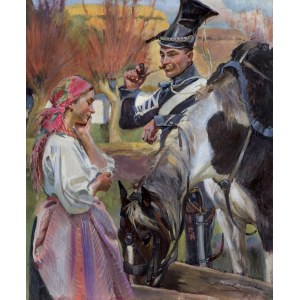
The painting belongs to a series of soldier idylls - scenes from the daily life of the cavalry. The dominant group are compositions with soldiers in the company of young country girls. Polish soldiers Wojciech Kossak painted both in contemporary and historical uniforms. They were always accompanied by a horse, the artist's favorite painting motif. With his art, Kossak created the ethos of the Polish soldier - brave and fearless in battle, and always warmly received under thatched roofs. In this way, the artist, creating during the Partitions, realized his national and independence mission. None of the ladies he painted refused to help the brave soldier. The paintings were meant to awaken national consciousness and encourage service for the glory of a free Poland.
The featured painting was signed by the painter in capital letters, which meant that he considered it an outstandingly successful work. Undeniably, Lancer's Courtship is an outstanding example of Kossak's painting virtuosity. The delightful composition is the author's replica of Soldier's Idyll painted in the same year, which was reproduced on the cover of the 52nd issue of Tygodnik Ilustrowany in 1911.
The excellent paintings of Wojciech Kossak enjoyed great success. Not surprisingly, the artist received numerous commissions for his awe-inspiring compositions and often reproduced them, changing certain details. However, Our Lancer's Courtship is an exceptional work, and its appearance on the antiquarian market is a treat for collectors of Wojciech Kossak's paintings. Apart from the featured painting, only one oil with an "idyllic" motif, mentioned above, is known so far.
Compare with:
- "Tygodnik Ilustrowany", 1911, no. 52, cover.
Wojciech Kossak (Paris 1856 - Krakow 1942 ) - widely known painter, seen primarily as a great battle artist. The son and pupil of Juliusz Kossak, he was educated at the Cracow School of Fine Arts, the Munich Academy and in Paris. In 1895-1902 he stayed mainly in Berlin, working for Kaiser Wilhelm II. He traveled extensively, including to Spain and Egypt, where he made sketches for intended panoramas. In later years, he traveled to the United States several times doing portrait commissions. In 1913 he was appointed professor at the Warsaw School of Fine Arts. During the years of World War I, he served in the military. He was co-author of panoramas: "Raclawice" (1893-1894), "Berezina" (1895-1896), "Battle of the Pyramids" (1901) and sketches for the unrealized "Somosierra" (1900). With temperament and freedom, he created extensively painted dynamic battle scenes, historical scenes, genre scenes and numerous portraits. He was fond of painting horses. His paintings, glorifying the Polish military and the heroism of soldiers, both ancient and contemporary to the artist, appealed to the patriotic feelings of the public and enjoyed great popularity.