


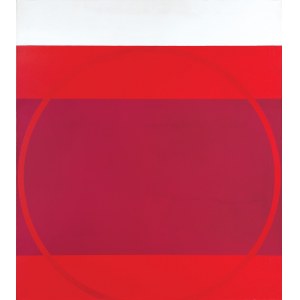
130,2 x 115,3cm - acrylic, canvas
Sign. on the reverse on canvas med: "AMARANT"
on the upper slat of the loom: Jerzy Kalucki 1998
The painting exhibited:
- Jerzy Kalucki. Paintings, Piekary Gallery, Poznan 15 IX - 9 X 2003.
For Jerzy Kalucki's art - classified as part of the geometric abstraction trend - critics have coined a separate term "philosophical constructivism." His painting, captivating in its simplicity, clarity of composition and purity of message, also contains a conceptual element. The artist built his paintings based on the author's concept of the so-called space of geometry: it is fictional, imaginary and exists only within the art. In it are geometric forms that do not represent any concrete, real entities, but only give us a suggestion of them. They serve to activate the imagination and evoke emotions (J. Deluga, Jerzy Kalucki. Transitions, Starmach Gallery, Krakow 2013, pp. 5-6).
The basic structural elements of the composition were the forms of circle, arc and ring rigorously subordinated to the vertical axis of symmetry. However, they were never entirely contained within the field of the canvas - they were deliberately widened, narrowed or deformed to stimulate the viewer to make the intellectual effort of entering the invisible space of geometry and, as it were, reaching the deeper, metaphysical layers of the work. The idea that guided the painter was aptly summarized by Bożena Kowalska: In addition to this rational, conscious and without resistance revealed, there is another side to his personality (...) It is the one that makes the purist austerity and rigor of geometry in his works mitigated by the factor of lyricism and that their mysterious space encourages meditation (B. Kowalska, Spaces of Jerzy Kałucki, Centrum Sztuki Galeria EL, Elbląg 2007, p. 116).
The painting presented in the catalog also does not allow one to be indifferent to the issue of color in Kalucki's art, which he treats equally with construction: My abstraction is somewhat different by its inclination to expression and color. Of course, the primary inspiration is space, but more and more often color also comes to the fore as a major component. (...) A bit like a composer, I use means of expression appropriate for musical pieces: color, contrast, rhythm. This is because I believe that color is like sound in music. Already in the 19th century, Aleksandr Scriabin created a concept based on looking at the relationship between colors and sounds. Color can also be heard... (Jerzy Kalucki, Transitions..., p. 13).
Stunning in its intense red, Amaranth carries a huge load of expression, while maintaining mathematical order and moderation. There is no doubt that such a consonant synthesis could only have been achieved by an artist operating a masterful workshop and endowed with extraordinary intuition in the choice of color and forms.
♣ to the auctioned price, in addition to other costs, will be added a fee resulting from the right of the artist and his heirs to receive remuneration in accordance with the Law of February 4, 1994 - on Copyright and Related Rights (droit de suite).
Jerzy Kalucki (Lviv 1931- Kraków 2022) studied at the Scenography Department of the Academy of Fine Arts in Cracow, receiving his diploma in 1957. He designed scenery for plays in theaters in Silesia (including the Silesian Opera in Bytom, theaters in Katowice and Sosnowiec), as well as for the TV Theater. Since 1981, he has taught painting at the Academy of Fine Arts (now the Academy of Fine Arts) in Poznań, since 1994 as a professor. He has exhibited extensively since the early 1960s, most often at the Krzysztofory Gallery in Cracow, where he had more than a dozen solo exhibitions. He also took part in group exhibitions of the Cracow Group, which he joined in 1976. He participated in events of the avant-garde movement in Poland, including: Koszalin Plein-Air, Osieki 1970; "Golden Grape" Symposia, Zielona Gora 1969 and 1975; "Space of the City," Chelm 1978; "Language of Geometry," Białowieża 1983. His painting explorations focus on the problem of space. Initially he created compositions similar in expression and manner of elaboration to the structuralist variety of matter painting, introducing elements of collage into his works. Since the 1970s, he has pursued explorations converging with conceptualism, creating objects and installations based on mathematical calculations and geometric studies of space using various materials. The artist also devoted theoretical works and texts to these matters, published in catalogs and art magazines.





Recentemente visualizados
Efetue login para ver a lista de itens
Preferidos
Efetue login para ver a lista de itens