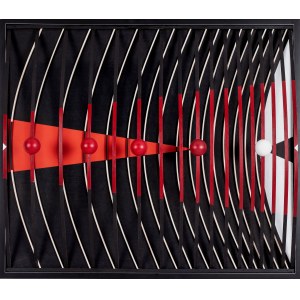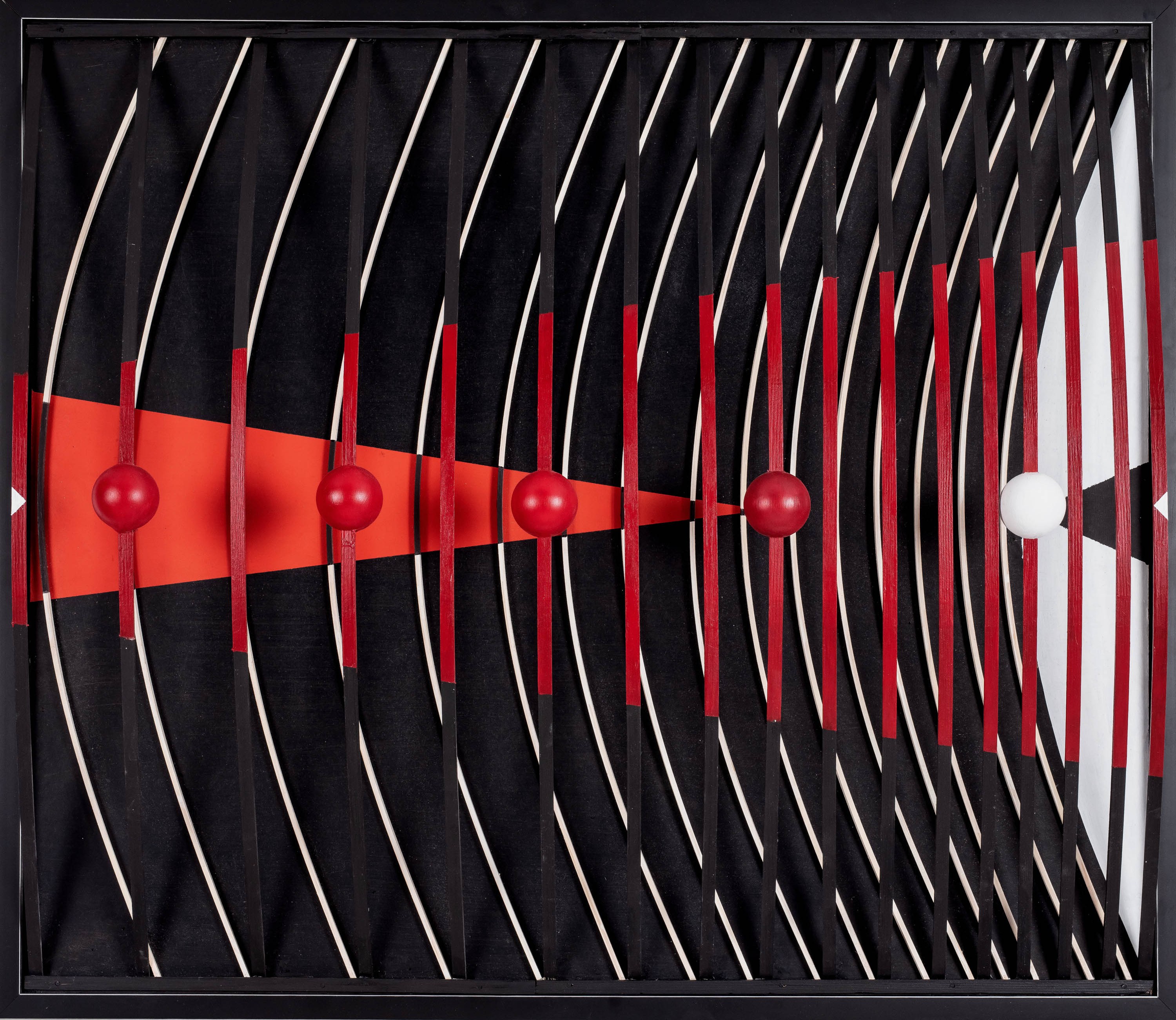
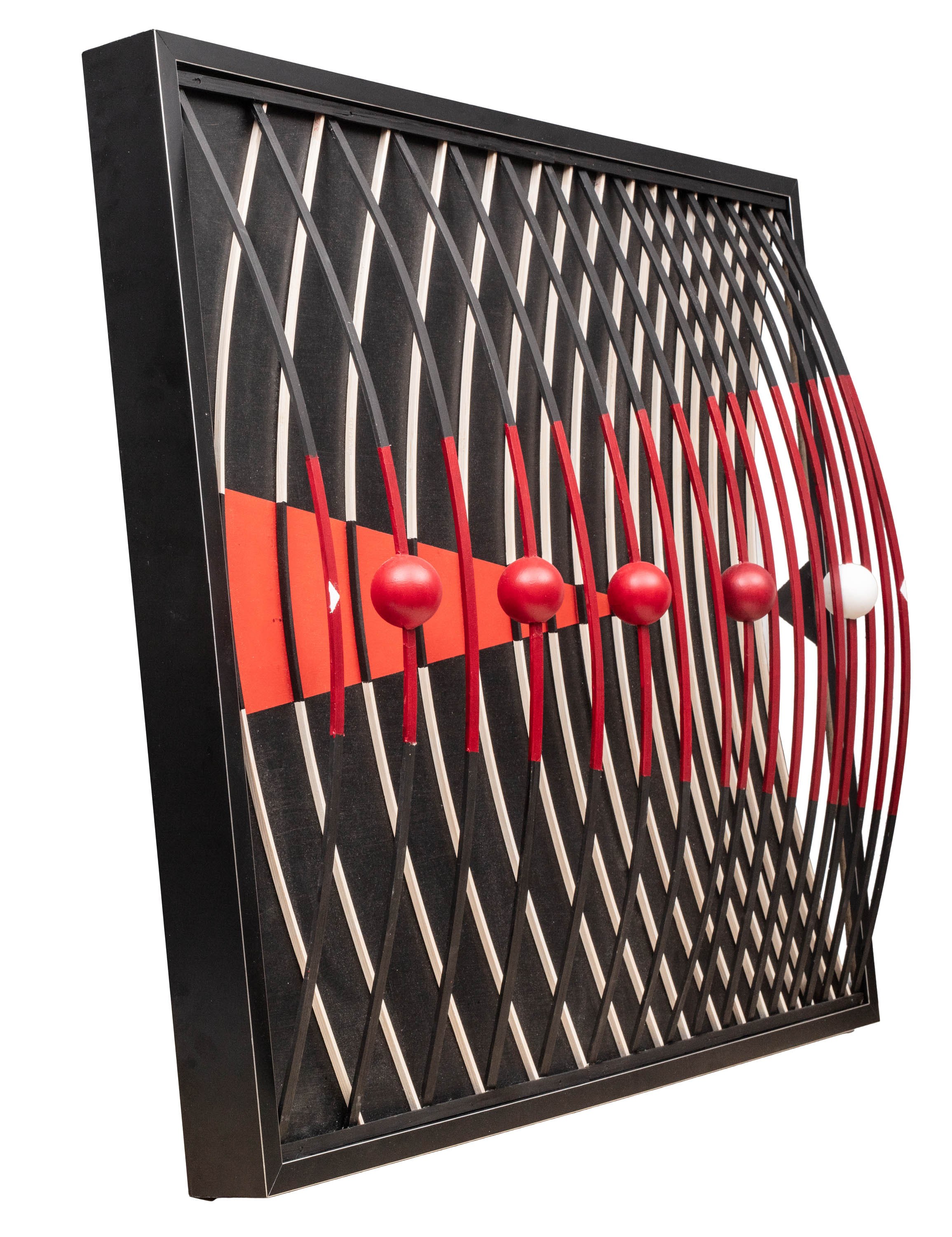
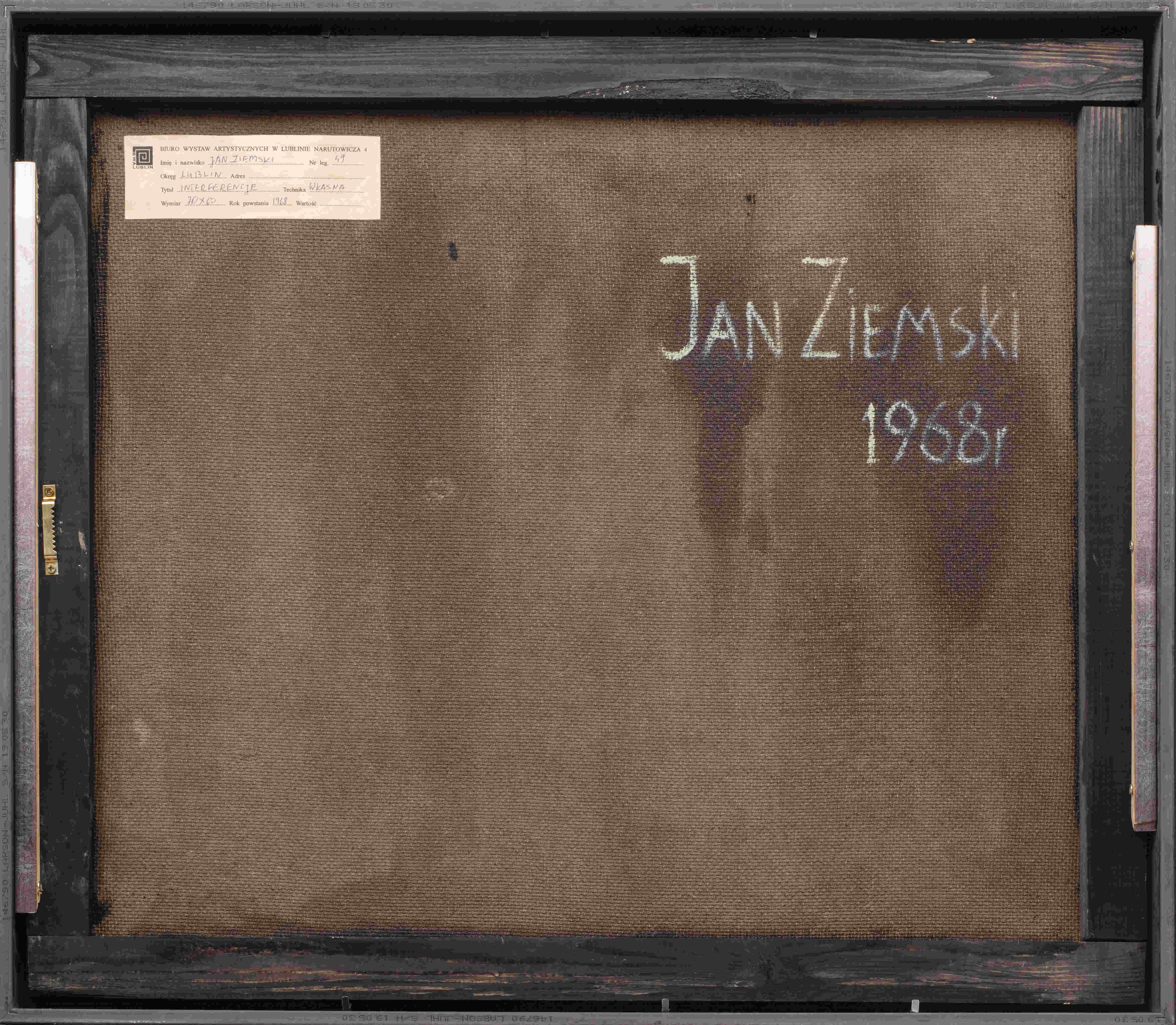
The presented work belongs to the "Interferences" series, one of the most important
created by Ziemski. Experimenting with spatial forms since the
mid-1960s, he created works from rhythmically arranged, spherically bent slats.
Ziemski pushed the boundaries of the traditionally understood image with his work.
He expanded its meaning and gave it new values. He invited the viewer to actively
reception of the work of art, offering him the role of co-creator.
The most important issue raised in "Interferences," "Permutations" and
"Optical Images" is not that which is frozen, tangible and visible at the "first
at a glance", but precisely that which cannot be fully perceived, which is noticeable only
in a momentary, brief moment, while in essence it remains elusive.
What is very important, and what Bożena Kowalska also pointed out, in the case of Jan
Ziemski, however, we are dealing not only, and not primarily, with a play on visual effects
visual effects, typical of American op-art, but with the anxious questioning of the
questioning the reliability and unambiguity of the testimony of the human senses. This is precisely the
interpretation of the work seems the most accurate. For apart from the fact that viewing the works,
which depending on the position of the viewer take on, like a chameleon, changing colors
or shapes is pleasant, the fact that they simultaneously stimulate the viewer to think
they stimulate the viewer to think, evoke many associations concerning, extremely close, relations
between the picture-relief plane and ways of perceiving the outside world.
After all, through the tangible element, Ziemski tried to find out the general truths that govern the
both macro- and microcosm.
Agnieszka Kuśnierz, Jan Ziemski (1920-1988) - creator of "non-existent" paintings, [in:] The "Castle" Group. History -
criticism - art, Scientific Society of the Catholic University of Lublin, Lublin 2007, p. 132.
ORIGIN:
- private collection, Poland
- purchase from Danuta Ziemska, widow of the artist
One of the leading representatives of the so-called matter painting. He received his artistic education while studying at the Janina Miłosiowa Free School of Painting and Drawing in Lublin (1942-46), while he consolidated his theoretical knowledge of the visual arts by studying art history at the John Paul II Catholic University of Lublin. He was a co-founder of the Lublin "Castle" group (1956-1959), formed among the students there, and counted among the most interesting and avant-garde Polish art groups, which included Włodzimierz Borowski, Ryszard Kiwerski, Tytus Dzieduszycki and Jerzy Ludwiński. Ziemski actively participated in a number of competitions and art exhibitions, such as the Biennale of Spatial Forms in Elblag, the Koszalin Plein-Air in Osieki, the Symposium of Artists and Scientists in Puławy and many others. Since the 1940s, he was interested in astronomy, space science and science fiction. The beginning of his artistic path is marked by surrealist works, among which frequent motifs were puppet-like figures (Mona Lisa, Semaphore). Gradually, his artistic technique began to mature in the direction of more abstract forms, suggesting a fascination with issues related to matter, which were reflected in the so-called "formuras" executed in plaster. Beginning in the mid-1960s, he turned to geometric abstraction, creating distinctive collage-like semi-spatial compositions of thin, spherically curved, mostly black, white and red slats. Many of these works belong to the op-art direction, using the laws of illusion, physiology and psychology of perception, theory of vision and color.