


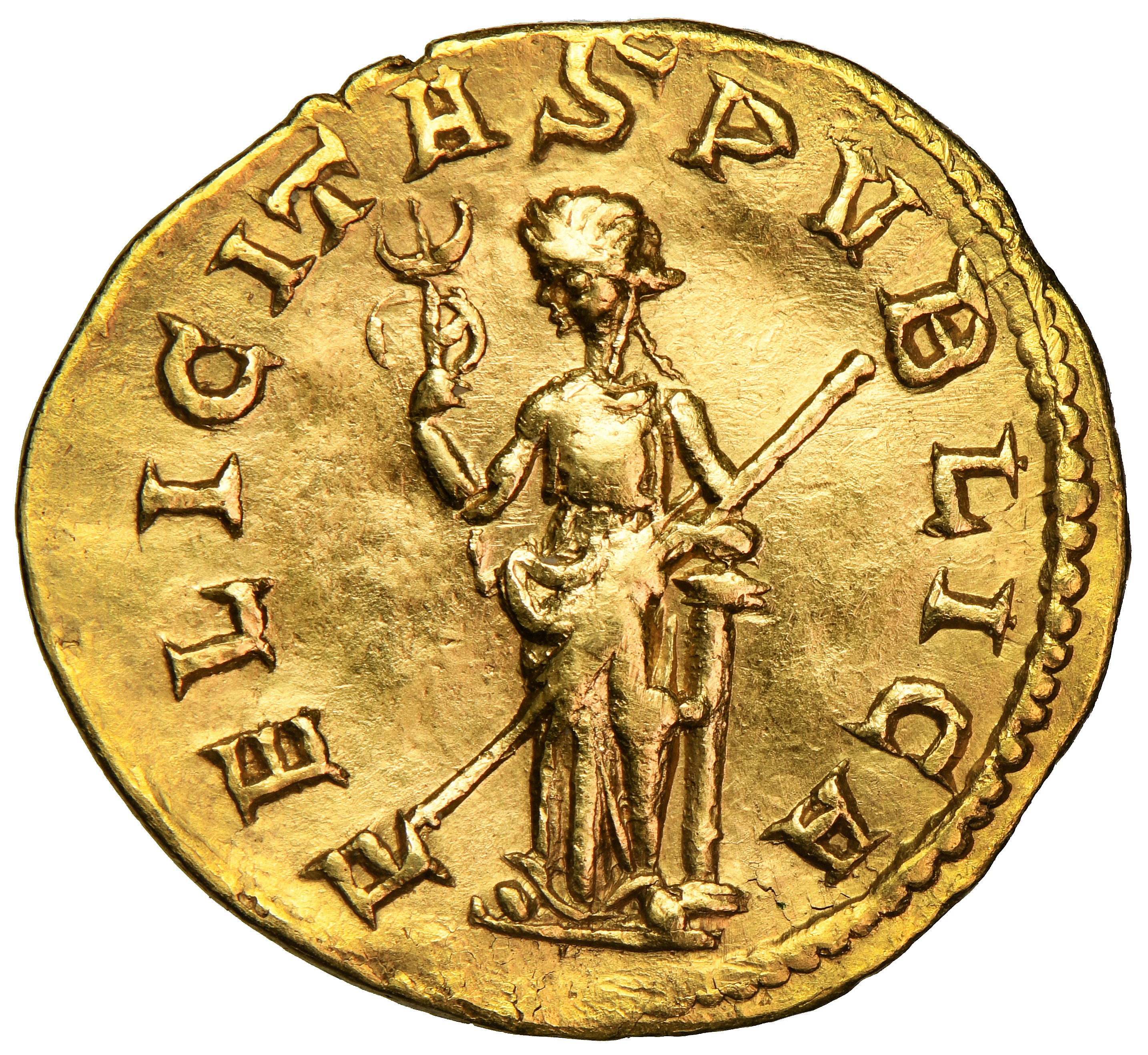
Roman Empire, Trebonianus Gallus, binio (double aureus), 251–253, minted in Rome.
Obv. Bust of Trebonianus Gallus wearing a radiate crown, armor, and a cloak, facing right, shown in a three-quarter view from behind. IMP CAE C VIB TREB GALLVS AVG.
Rev. Felicitas stands facing forward with her head turned to the left, holding a short caduceus and a long scepter, resting her left elbow on a small column. FELICITAS PVBLICA all around.
Gold, 5.47 g, 22.5 mm, axis 12 g. Calico 3333b; cf. RIC IV.3 p. 160 no. 8 (Felicitas with a caduceus and cornucopia).
Condition II
Over the years, the weight of the aureus—the basic Roman gold denomination—gradually decreased. As late as the 1st century AD, it weighed about 7.5 g, whereas by about 250 AD, it weighed only half that amount. During the reign of Trebonianus Gallus, gold coins began to vary greatly in weight, as the established standard was not strictly adhered to. Furthermore, this emperor was the first to introduce the binio on a large scale—a coin weighing about 1.5 times more than the aureus, featuring a portrait with a radiate crown. This is an obvious analogy to the measure implemented in 215 by Emperor Caracalla for silver coins, which resulted in the introduction, alongside the existing denarius, of a denomination known today as the antoninianus. Most likely, the binio was valued at one and a half or twice the weight of the aureus (the average weight of a Trebonian Gallic binio is 5.75 g, while that of an aureus is 3.60 g), similar to the antoninianus relative to the denarius. It is believed that binia were not coins intended for circulation, but rather a kind of donation in the form of rewards or gifts.
The specimen presented here belongs to the rarer FELICITAS PVBLICA variety, on which Felicitas holds a scepter rather than a cornucopia and leans against a column. The ACSearch.info website lists only three such pieces, against which our piece stands out much more favorably.









