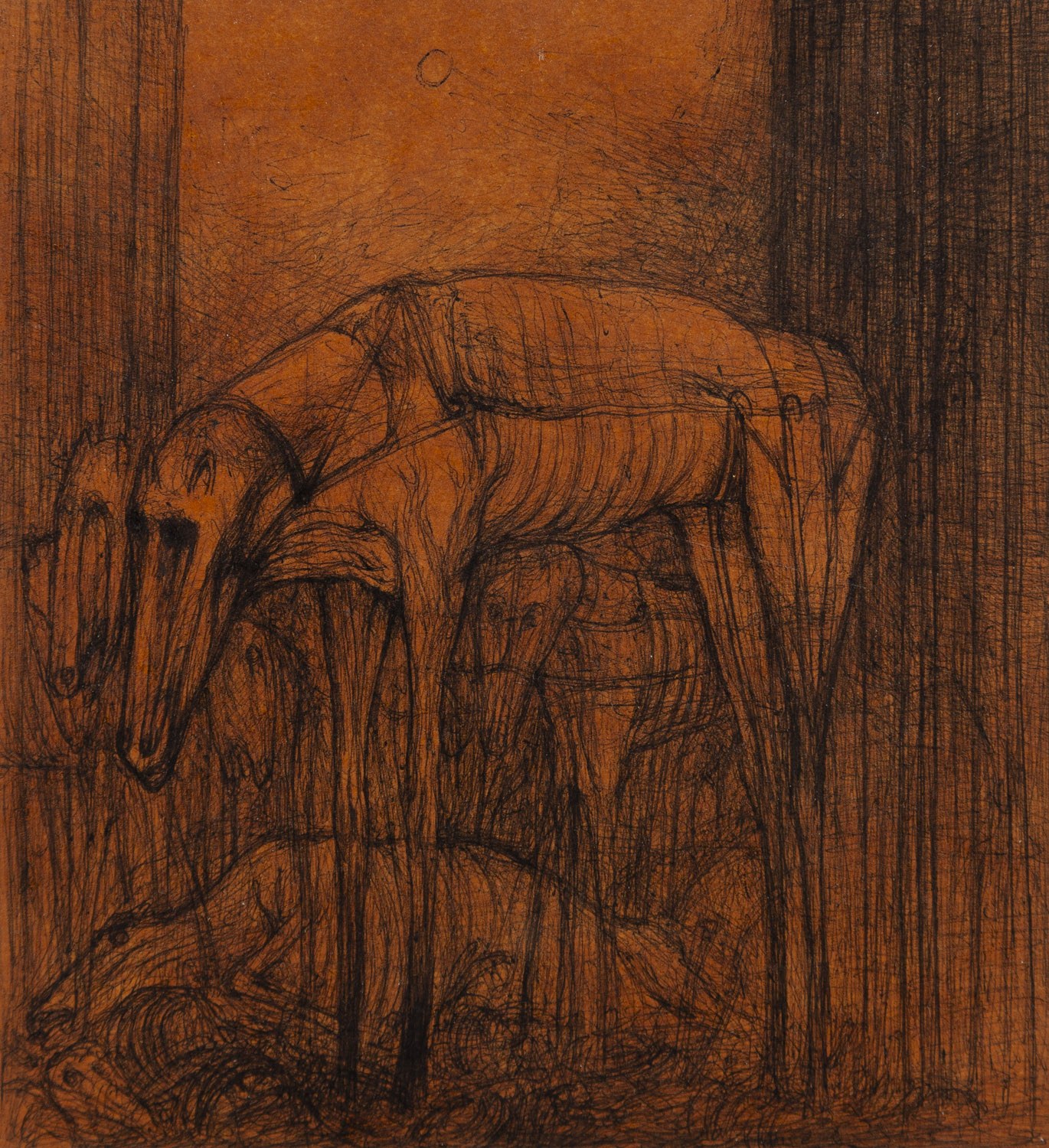
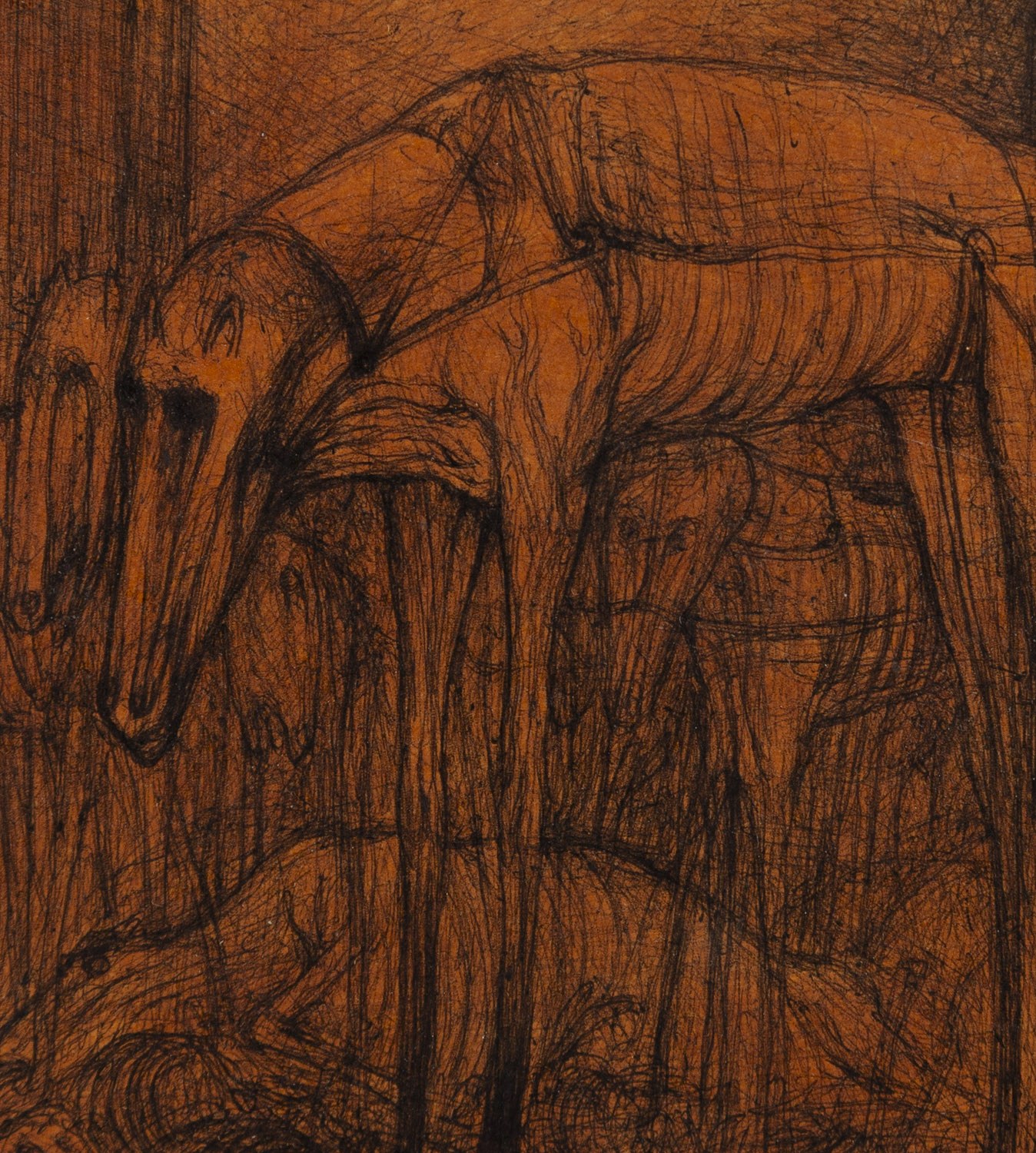
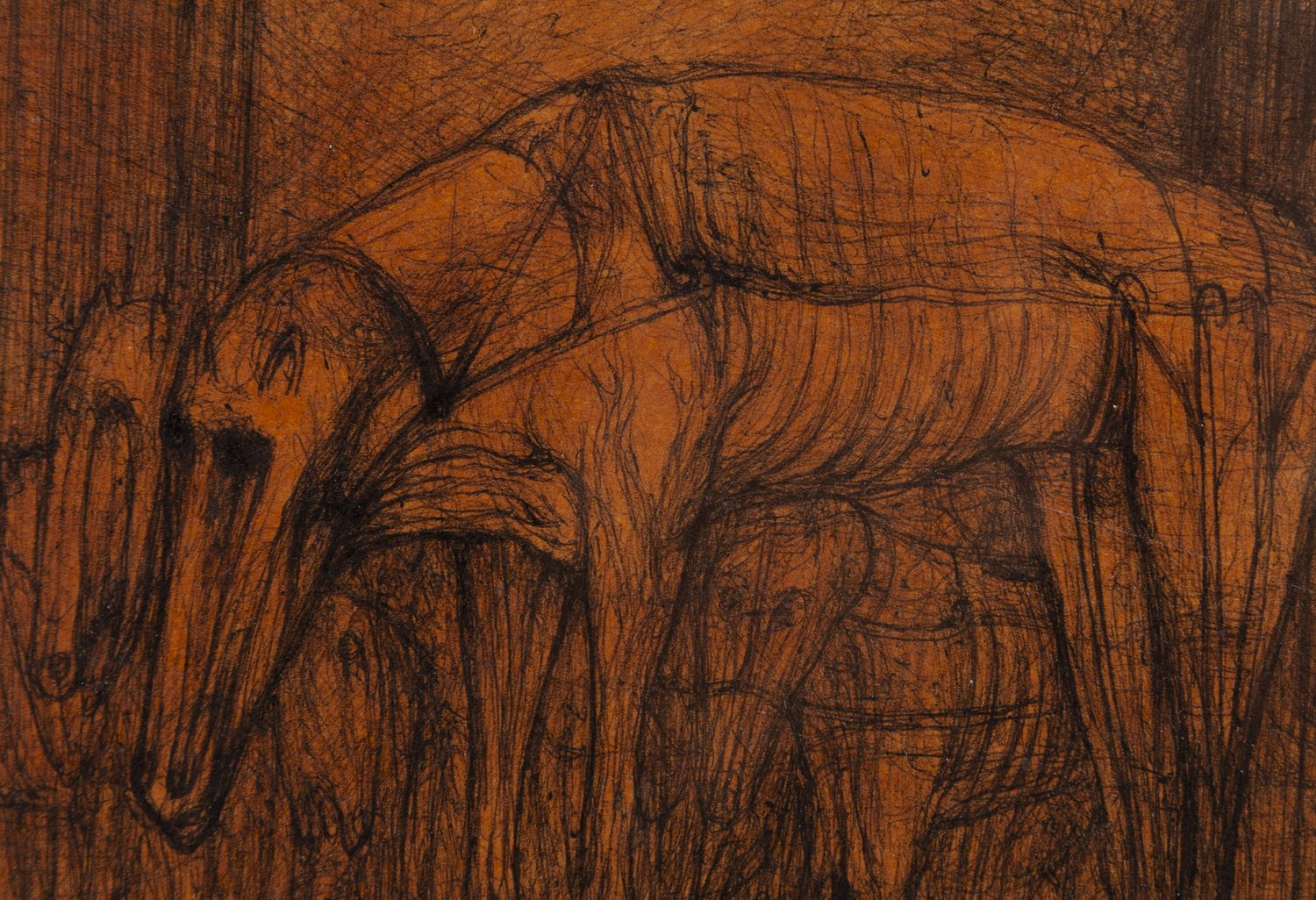
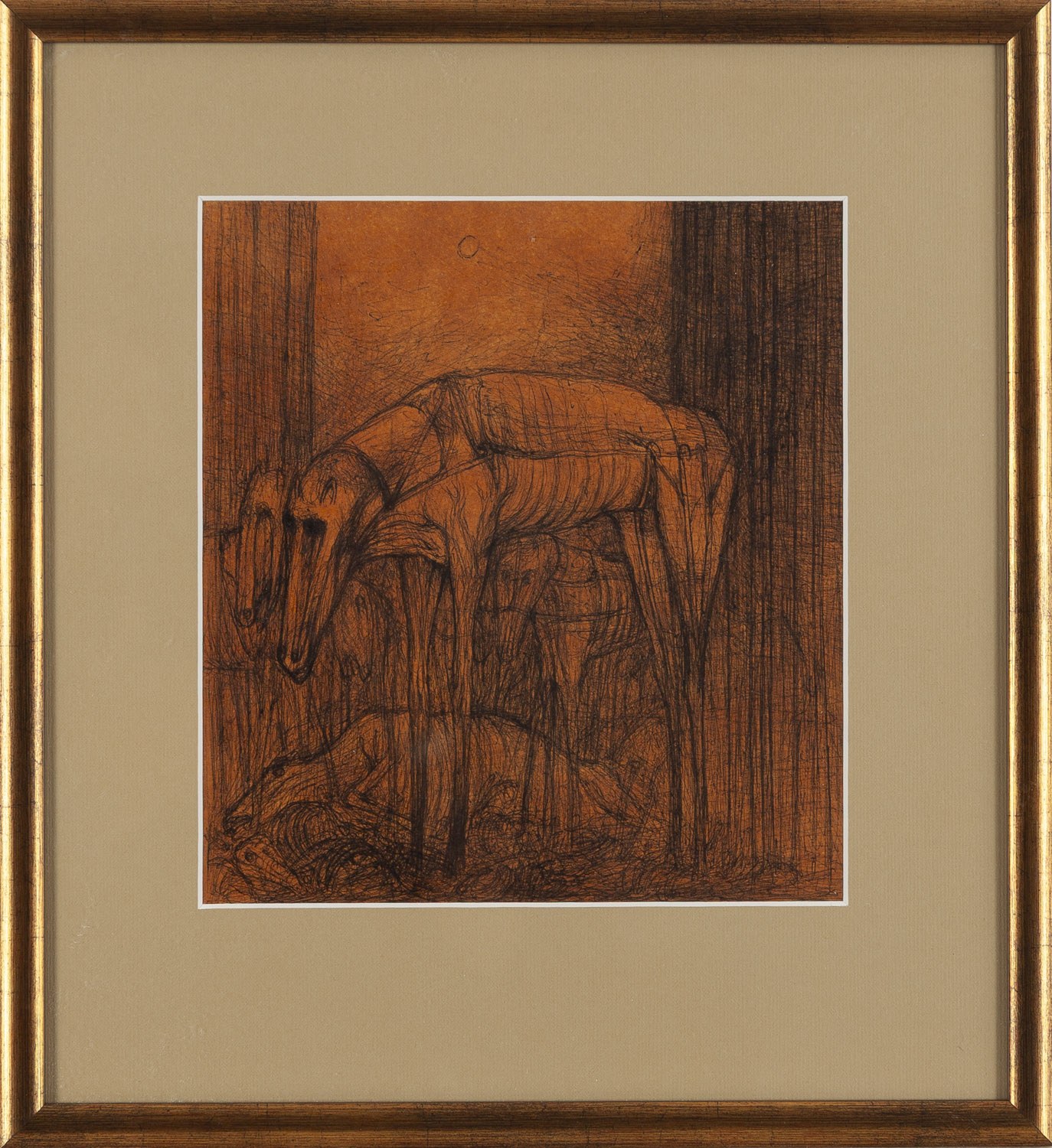
Dimensions: 20 x 18.5 cm (inside the mat)
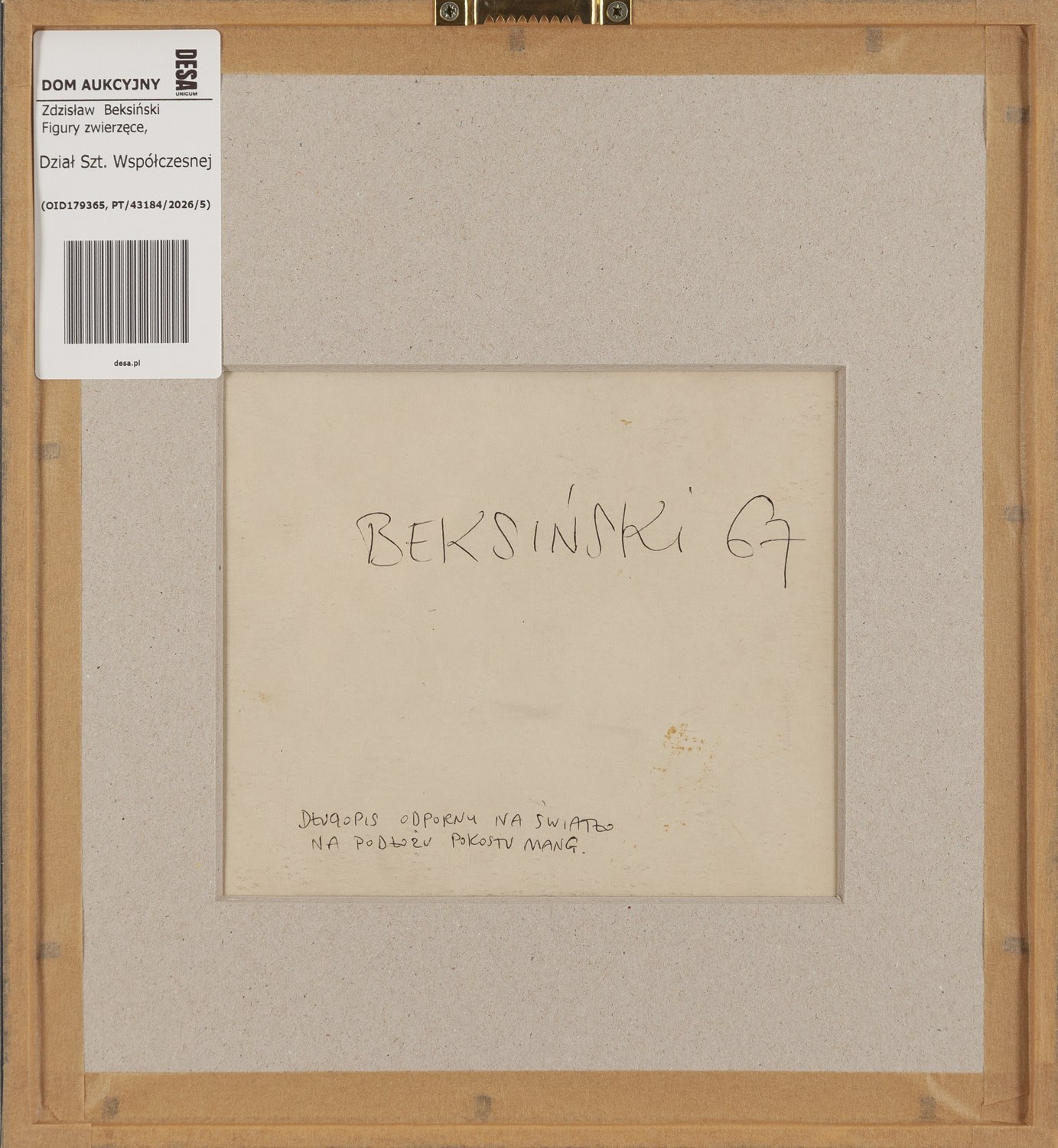
Signed, dated, and inscribed on the reverse: 'BEKSIŃSKI 67 | LIGHT-RESISTANT PEN | ON A MANG. VARNISH BACKING.'
Condition
Work mounted
Biography
Born in 1929 in Sanok, he was a photographer, graphic artist, illustrator, and painter. He studied at the Faculty of Architecture at the Kraków University of Technology. In the late 1950s, he worked as a designer-artist in the Chief Designer’s Department at the “Autosan” Factory. He began his artistic career as a photographer. In 1957, an informal group was formed—Beksiński, Lewczyński, and Schlabs—which remained active until 1959. The artists’ final exhibition took place at the Deutsche Gesellschaft für Fotografie in Cologne, organized by Otto Steinert.
From 1957 to 1963, Beksiński was a member of the Association of Polish Visual Artists and the Association of Polish Photographic Artists. At the turn of the 1950s and 1960s, he drew inspiration from the poetry of Rainer Maria Rilke and existential themes. The artist’s photographic body of work is preserved at the National Museum in Wrocław and serves as a representative example of 20th-century Polish photography. The artist’s primary model was his wife, Zofia Beksińska. His early depictions of feminine beauty began to evolve into experimental photography featuring bandages or string, as seen in “The Sadist’s Corset.”
In the mid-1960s, he broke with popular avant-garde thought and began to devote himself largely to painting. He argued that modern art was receding into the background, while the search for a synthesis among conflicting artistic directions was drawing attention. This led to the emergence of postmodernist ideas. He also created sculptures from plaster and metal, drawing inspiration from the work of Henry Moore. Beksiński’s work was popularized by an exhibition organized by Janusz Bogucki in 1964 at the Stara Pomarańczarnia in Warsaw. The exhibition was guided by the idea of Beksiński’s contradictions and the juxtaposition of innovation with traditionalism. From the late 1960s to the early 1970s, motifs from the Far East began to appear in his work. His works from the 1980s are characterized by an interweaving of Baroque and 19th-century motifs with a strong erotic emphasis. They were described as “photographs of dreams.” In the 1990s, he began incorporating computer graphics into his work, based on his private collection of photographs.
The artist, who died tragically in 2005, is highly regarded outside of Poland, particularly in South Korea, Japan, and the United States. His works are held in numerous museums and galleries in Poland, including Sanok (which houses the most extensive collection of the artist’s works), Warsaw, Kraków, Częstochowa, and Wrocław. He is the only Polish artist whose works have been exhibited at the Osaka Museum of Art in Japan.
The artist was associated with Piotr Dmochowski—an enthusiast of Beksiński’s art and his art dealer. The first exhibition organized as part of their collaboration took place at the Valmay Gallery in Paris in the fall of 1985. The exhibition garnered significant attention. Subsequently, from 1989 to 1996, Piotr Dmochowski opened an art gallery in France dedicated to the artist’s work. The art dealer describes the artist’s work as a source of wonder and love at first sight, when he and his wife visited the Warsaw Art Exhibitions Office.
The life and art of Zdzisław Beksiński are a phenomenon that extends far beyond art-loving circles—they can be considered part of pop culture. The artist and his family have inspired the creation of many outstanding books, monographs, catalogs, and more. In 1964, the first film dedicated to the artist, *Fotoplastykon*, was released, directed by Piotr Andrejev. In 2016, the film *The Last Family*, directed by Jan Matuszyński, was released and won numerous awards, including the Silver Leopard for Best Actor—awarded to Andrzej Seweryn. In 2017, the documentary *Beksińscy. A Videophonic Album*, directed by Marcin Borchardt, and the short film *Pars Pro Toto*, directed by Katarzyna Łęcka, were released. In addition, a play directed by Jerzy Satanowski, “Beksiński: Untitled Painting,” as well as a dance and music spectacle directed by Agnieszka Glińska—Art Color Ballet’s “CODE NAME 27.” Beksiński’s influence even extends to the world of fashion. In 2017, British Vogue published photos from the fall/winter show at London Fashion Week. The collection by award-winning Polish designer Joanna Berling, who drew inspiration from Beksiński’s work for her show, was featured there. In 2021, the Bytom brand created a collection in collaboration with the Historical Museum in Sanok. The artist’s works appeared on blouses and jackets. Japanese designer Yoji Yamamoto took an interest in Beksiński’s paintings and created collections for the Fall-Winter 2022/2023 season. The Beksiński Foundation, established in 2006, is also actively involved. The foundation’s goal is to promote the artist’s work and the Historical Museum in Sanok, which houses the largest collection of the artist’s works.


![Zdzisław BEKSIŃSKI (1929-2005), Bez tytułu [7], 1958](https://img1.one.bid/img/7081/2022469_1w.webp)