


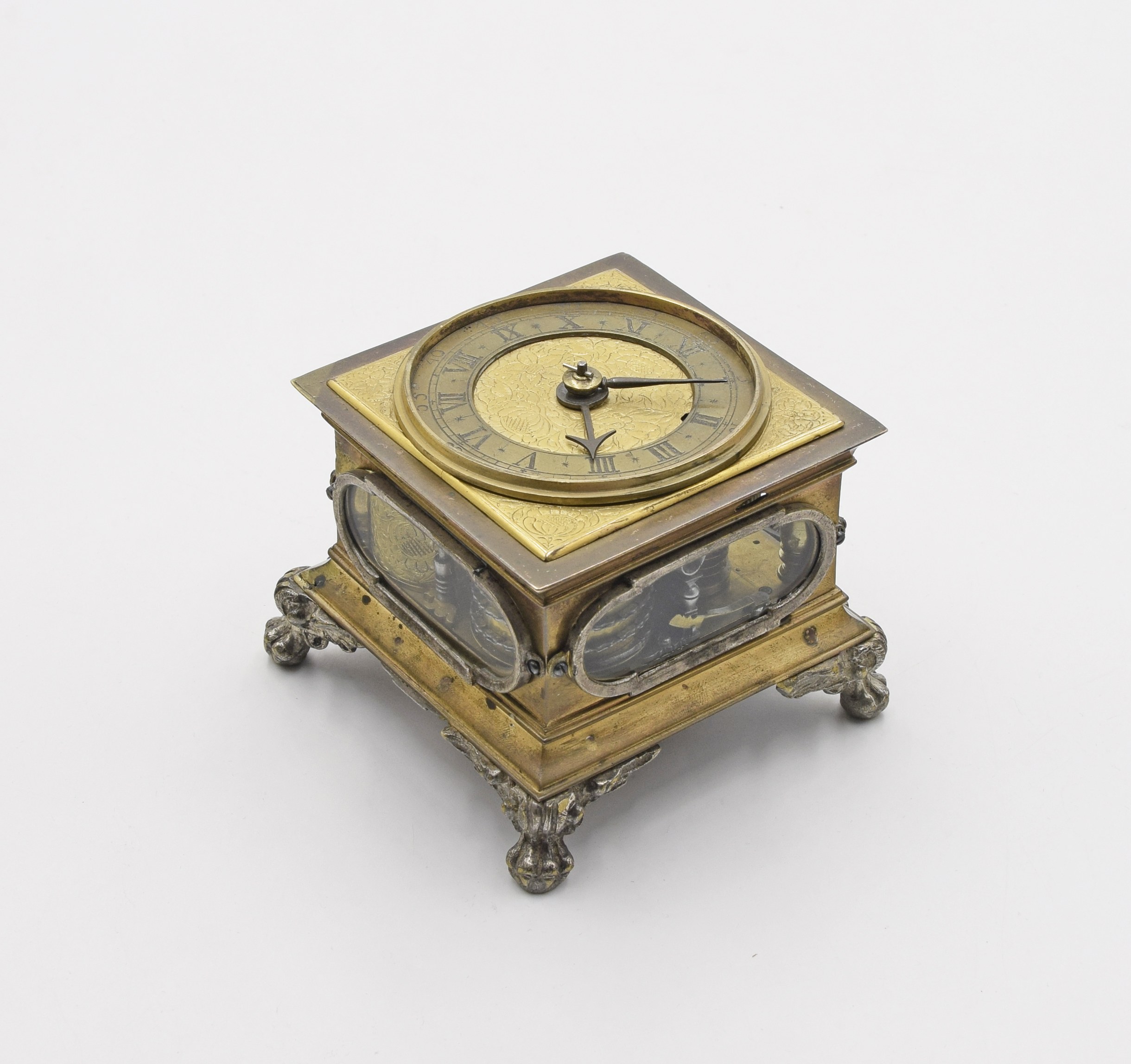
mechanism: brass, steel; bell: bronze; case: partly gilded brass, silvered copper, glass; casting, cutting, engraving, chiseling, oxidizing, gilding, silvering;
8.1 x 9.5 x 9.5 cm; dial: 7.5 x 7.5 cm; digital ring: diameter 6.8 cm. width 1.2 cm;
signed on lower panel: Lucas / Weidman / Cracow"
Cracow, Lucas Weidman (Wevdman), 1660-1670.
Tiled clock with two hands, with a mechanism with a plate skeleton and a spring drive, beating the hours, enclosed in a four-sided case supported by four silvered legs in the form of winged paws holding balls. The case with glazed walls. Windows framed in profiled oval frames, with rectangular
indentations on the short axis. Profiled cornices with concaves. In the lower copper rebated lid a bell on a silver-plated stirrup. Gilded dial with applied wide brass ring, edged with profiled orifice, with engraved Roman hour numerals separated by stylized florets, with minute scale and Arabic minute scale on outer perimeter. The center field is filled with an engraved composition of lush flowers, whose heads also decorate the corners of the dial.
The hands are oxidized, the hour hand ending in an arrow, the minute hand spindly. Brass skeleton with plates joined by four turned baluster pillars. Gait drive with compensating worm and Gallic chain. Spinel escapement adjustable by balance. Ratchet beating section with drum decorated with engraved floral thread ornament. Lower plate with English-type, open-work, engraved chignon, filled with floral vittae with bell-shaped flowers. The foot of the chignon is gilded, decorated with a cut-out appliqué of swirling stems of flowering strawberries. Sliding balance hair adjustment with engraved scale and letters: "A[dvance] - R[etard]". The spring of the pawl of the gait drum is steel with decorative moustaches ending in trilliums, covered with an openworked, gilded application decorated similarly to a chignon.
The clock case is typical of tiles from around the mid-17th century. - four-sided, plain, with slits with a characteristic frame design, supported by winged paws holding spheres. It is undoubtedly distinguished by the elaborately engraved floral composition decorating the shield, testifying to the skilled hand of the engraver.
Also noteworthy is the intricate workmanship of the openwork decoration of the lower plate - the foot of the chignon and the cover of the spring of the pawl of the gait drum. On the other hand, the decoration of the chignon, which, admittedly, quite faithfully repeats the motif of strawberry flowers, lacks finesse and subtle precision of finish. It was probably made secondarily, perhaps as early as the 18th century.
State of preservation: non-original digital ring, hands and bun, traces of solder at the base of the bun, added corner of the cornice, rubbed silvering.
Nothing is known about the author of the clock. There is a lack of any archival information. It is presumed that it was specially brought by Jan Kazimierz, as his court clockmaker [Siedlecka 1988, p. 67].
Undoubtedly, he was an outstanding clockmaker, as best evidenced by a surviving turret clock of his authorship, now in the collection of the British Museum in London -- with an exceptionally elaborate iconographic program and the date: "1648" The clock was owned by King John Casimir who, like his father Sigismund III, was a passionate collector of clocks. After his abdication, he took his entire art collection (including 38 clocks) with him to France After the King's death, the clock became the property of his sister-in-law Princess Anna Gonzaga, sister of Queen Marie Louise. In 1867, it was donated to the British Museum by Octavius Morgan (inv. no. 1867.7-16.4 [see also Thompson 2014, pp. 28-31]).
In an article in Encounters with Antiquities, Jan Samek mentioned two more surviving tile clocks signed by Weidman [Samek 1992, p. 39]. One was supposedly in some unspecified collection in the Netherlands, while the other was in the Camillian monastery museum (now defunct) in Taciszewo near Gliwice. It was donated there by the sacramental nuns who came from Lviv and settled in a palace in nearby Pławniowice. Unfortunately, there is no detailed description of the clock or at least a characteristic that would allow its identification. From the laconic information, it appears that it had about 8 x 10 x 10 cm, only one hand, a spring drive, glazed side walls, decorative legs and was signed: "Lucas Weidman Cracov", It is not clear on what basis Samek dates it to 1634. Could there be some inscription on it? Also attached is a rather schematic drawing of the described tile. It does not show
decorative details on it, but the form of the case, the shape of the window legs resembles the clock discussed here.
According to information obtained from Konrad Nawrocki, there is another Weidman clock in the private collection, signed "Lucas / Weidman /" (further part of the signature found in the kok), with a lunar calendar and moon phases, decorated in the center of the dial face with a genre scene with a galloping horseman in the foreground and city buildings in the background, and in the corners with flowers very similar to those on the discussed clock.





Recentemente visualizados
Efetue login para ver a lista de itens
Preferidos
Efetue login para ver a lista de itens