


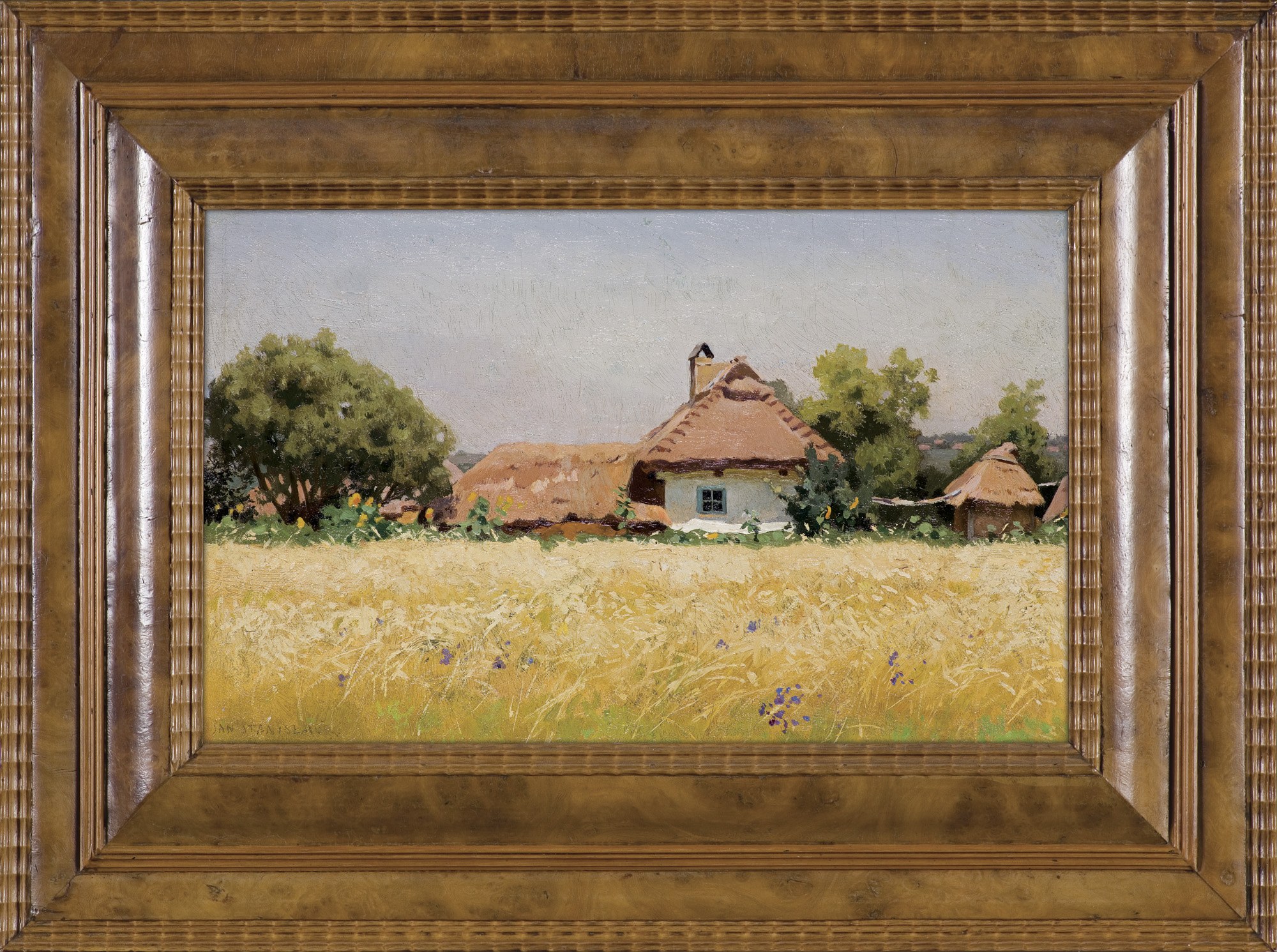
19,2 x 31,2 cm - oil, canvas glued on board
Signed l.d.: JAN STANISŁAWSKI
On the reverse, notations in French and a sticker of a framing workshop in the shape of a palette: DORURE & ENCADREMENTS | ED. BADOIS | 44 & 46 Rue Miromesnil | PARIS.
Jan Stanislawski initially planned to become a mathematician. It was in this field that he studied at the University of Warsaw and the St. Petersburg Institute of Technology. Visits to the Hermitage were immensely important in changing his interests. From then on, it was art that captured his soul. In 1883 he went to Krakow and joined the students of the School of Fine Arts in the studios of Izydor Jablonski and Wladyslaw Luszczkiewicz. However, the Krakow academy was unable to meet the young artist's expectations. In 1885, Stanislawski left for Paris, where he studied with the historical painter and portraitist Carolus Duran. At that time, he created a series of tiny landscapes commemorating the artist's trips to his beloved Ukraine.
French trends did not revolutionize the art created by Stanislavsky, but the theories promulgated by the Impressionists confirmed him in the right direction. The artist devoted himself to small forms, easy to transport, created outdoors.
In 1890 Stanislavski presented his works at the Salon du Champ de Mars. The recognition he gained among the Parisian public allowed him to sell a large number of his poetic landscapes.
As the artist's friend Nikolai Nesterov wrote in his memoirs: Reiche buys 30 studios from him, paying 20 francs apiece, mentioning this, Stanislavsky used to say that he never felt so rich! Soon the prospects of even greater riches shone before him, when both he and Chelmonski were offered by Goupil to paint exclusively for him. However, the love of freedom was too strong in these artists that they both rejected such alluring proposals.
The work on display is an excellent example of painting from the early period of Jan Stanislavski's career. A delightful landscape, full of warmth, bathed in sunlight, it is one of the few surviving works from this time. Stanislavsky was a reverent nature worshipper who initially reproduced nature with remarkable realism. The painting shows a simple motif - a country cottage, but rendered with extraordinary sensitivity to light and the color it brings out.
Jan Stanislawski (Olshana in Ukraine 1860 - Krakow 1907) - an outstanding landscape painter, printmaker, educator - was one of the most colorful figures of the Krakow artistic milieu of the Young Poland era.
Initially in Warsaw and St. Petersburg, he studied mathematics, then painting under Wojciech Gerson in Warsaw, Władysław Łuszczkiewicz at the Cracow School of Fine Arts, and in 1885-1888 under Carolus Duran in Paris. He traveled extensively in Europe - he went to France, Italy, Spain, Switzerland, Germany, Austria, the Czech Republic, and traveled to Ukraine many times. In 1895 he was in Berlin, where he collaborated with W. Kossak and J. Fałat in painting the Berezina panorama. In 1897 he became a professor of landscape painting at the Cracow School of Fine Arts, the creator of the so-called Cracow School of Landscape. He educated nearly 60 students, including S. Kamocki, H. Szczygliński, S. Filipkiewicz, I. Trusz and S. Galek. He was one of the founders of the Society of Polish Artists Art (1897), a member of the Society of Polish Applied Art (1901). He participated in many exhibitions.
Initially, he painted realistic landscapes based on preparatory studies from nature (numerous surviving sketchbooks). His later fascination with Impressionism led to experiments with light in landscapes and an increasing desire to synthesize color forms. During his travels, he created hundreds, mostly miniature landscapes painted directly in the open air. He worked in printmaking, illustration, and designed posters and theater decorations.





Recentemente visualizados
Efetue login para ver a lista de itens
Preferidos
Efetue login para ver a lista de itens