


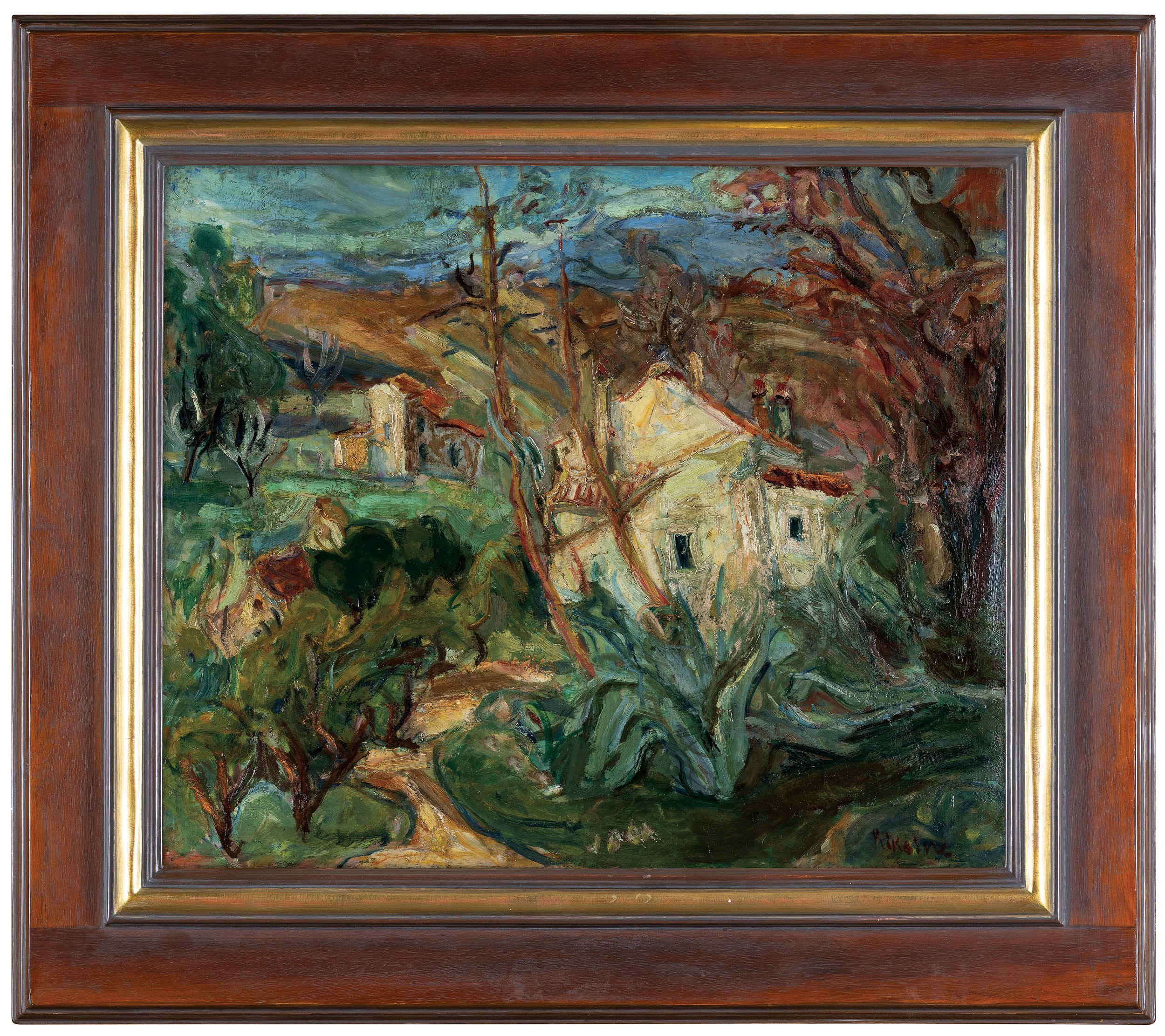

54,2 x 65,2cm - oil, canvas
Signed p.d.: Kikoine
On the back, on the lower loom strip, sticker with barcode and number: 03077153; next to it, sticker with number (in black marker): KR092 | L/31.
Image reproduced and described:
- E. Roditi, M. Mann, J. Yankel, Kikoine, Edition d'Art H. Piazza, Paris 1973, cat. no. 108, il. s. 248.
Michel Kikoine's landscape paintings are among the most prominent examples of the work of the Expressionist movement within the École de Paris, which he co-founded with artists such as Chaim Soutine and Pinchus Krémegne. Paris at the turn of the 20th century was a place where artists of different nationalities, enjoyed great creative freedom. This allowed Kikoine to develop his own authorial painting language and become independent of official academic styles. His friendship and closeness with other key figures, the aforementioned Soutin and Krémegn, whom he had already met before going to Paris, was crucial. The work of the three, who attended the Vilnius Drawing School together, is often considered together because of the similar kind of violent, emotional expression evident in both landscapes and portraits. The Vilnius trio, introduced to Parisian art a type of Expressionist painting that was a specific combination of borderland empathy and emotional temperament. In Paris, on the other hand, they came into direct contact with the post-impressionism of van Gogh or Cézanne, as well as early Cubism, which provided them with tools for stylization and geometrization of forms.
The presented Kikoine Landscape does not faithfully reproduce nature, but is characterized by deep subjectivity, reflecting the artist's emotional state. The landscape shows his individual style, which was characterized by dynamic brushstrokes, rich textures and a vibrant color palette, combining influences from the Russian landscape tradition with Expressionism. Of the schools of French painting of the time, Kikoine is more akin to the one that remained faithful to Renoir's style. In his works, an interest in color is more evident than a careful analysis of form, as in the case of the Cézanne school. The lines move quickly, forming abrupt curves, sometimes reminiscent of van Gogh's style, supporting each other until the painting is complete.
The strong deformation and synthesis of form used by the artist emphasized the dynamism of his landscapes. The horizon line and perspective are shaky, and the architectural elements and plants around seem to be subjected to internal vibrations. The deformation serves to reflect the artist's emotions during the plein air. The painter uses a saturated, intense color palette, which has also become a tool of expression. In the presented canvas, one can see, characteristic of Kikoine, the expressive texture of paint applied impasto, with free, dynamic brushstrokes. This way of painting added drama to his landscapes.
Kikoine's landscape painting is a subjective and emotional representation of nature, shaped by the expressionist tendencies of the École de Paris. It combines an Eastern temperament with the formal achievements of Post-Impressionism and French Cubism to create unique, sometimes disturbing visions of the world in which color and texture dominate over content.
♣ A fee will be added to the auctioned price in addition to other costs, based on the right of the artist and his heirs to receive remuneration in accordance with the Law of February 4, 1994 - on Copyright and Related Rights (droit de suite).
Michel Kikoine (Gomel, Belarus 1892 - Cannes 1968) - painter born in Belarus, working within the framework of French art. He began his education in Minsk, at the private drawing school of Jakub Krüger. There he became friends with Chaim Soutin, with whom he studied at the Vilna Drawing School in 1908-1911. In 1912 they both left for Paris, where Kikoine was still studying at the Ecole des Beaux-Arts with Fernand Cormon. At the time he lived in the famous "La Rouche" and was friends with many artists, including A. Modigliani. During World War I, he served in the Foreign Legion. In 1924 he received French citizenship. He often traveled to the south of France, and from 1926 had his own house in Annay-sur-Seine, Burgundy, where he spent the summer months. He temporarily lived in Montrouge (1927-1933) later in Paris. From 1939-1940 he served in the army, then went into hiding in Toulouse. After the war he returned to Paris. He participated in numerous exhibitions in 1912 he debuted at the Salon des Independents, in 1919 he had his first solo exhibition at the Gallerie Chéron in Paris. He took part in the Autumn and Independent Salons, among others, and exhibited at the Paris galleries Bernheim, de la Licorne and Billet-Worms, as well as in New York, Moscow, London and Brussels. He was associated with the marchand Leopold Zborowski, and had solo exhibitions at his gallery in 1924 and 1928. Kikoine is considered one of the most important artists of the Ecole de Paris. In his earlier period, he painted mainly Post-Impressionist cityscapes in light color tones. After World War I, he created expressionist portraits, nudes and landscapes with intense, saturated colors and a serene mood.













Recentemente visualizados
Efetue login para ver a lista de itens
Preferidos
Efetue login para ver a lista de itens