


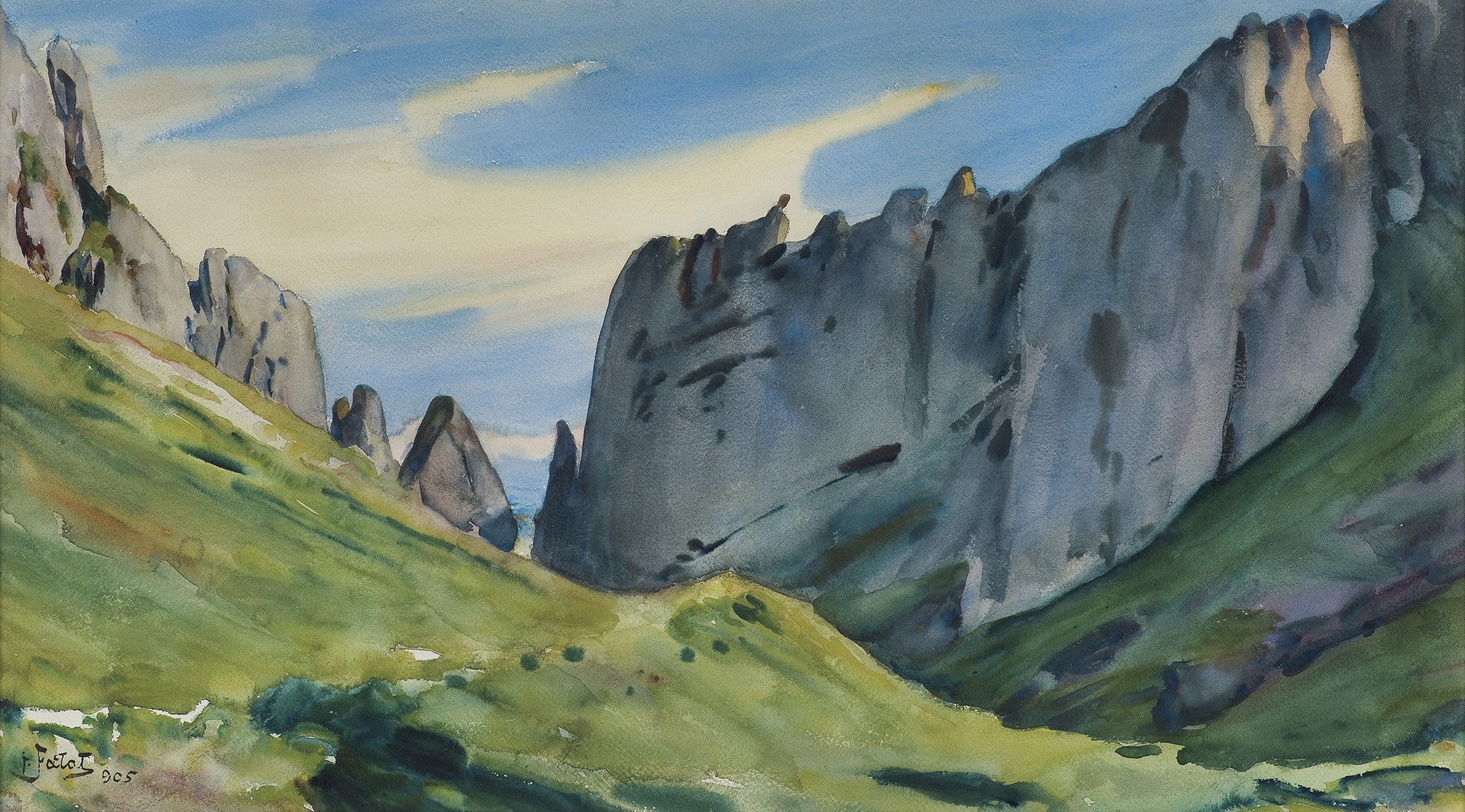
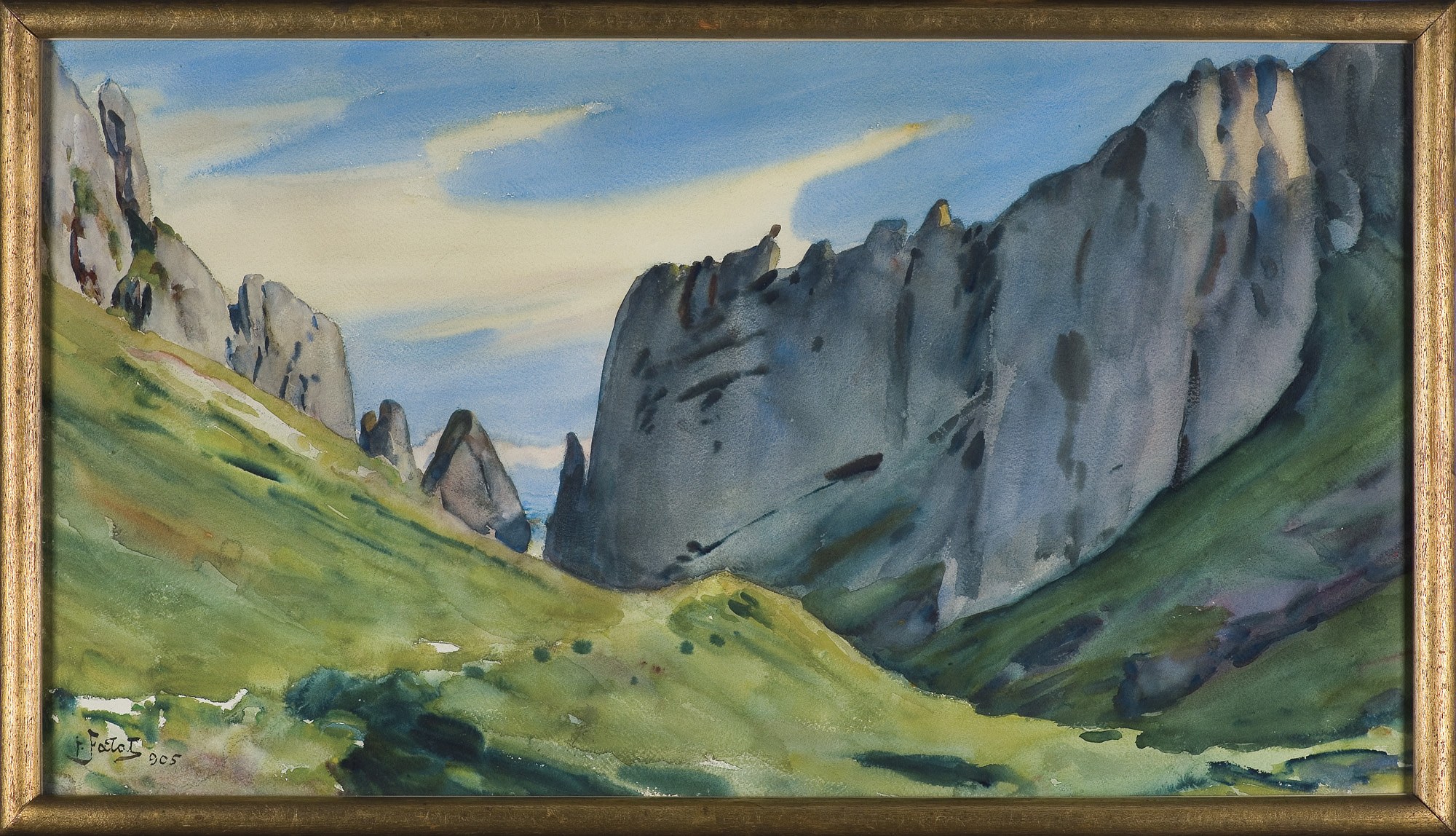
54.0 x 98.0 cm - watercolor, paper signed l.d.: J. Fałat 905
Provenance:
The painting comes from the collection of Zygmunt Ziembicki. Information about the collector at item no. 21.
Image mentioned and reproduced:
- Tadeusz Z. Bednarski, Krakowsko szlakiem Juliana Fałata, Secesja Publishing House, Krakow 2005, pp. 183-185.
In the circle of Krakow themes, it is difficult not to mention a landscape watercolor from 1905. Bolechowicka Valley. The painting has a beautiful painterly solution using chiaroscuro and natural arrangement of rocks. (...) This is one of the most interesting compositional solutions in the artist's work, where the diagonal arrangements were prompted by the terrain. The beautiful terrain of the southeastern part of the Krakow-Czestochowa Upland.
Tadeusz Z. Bednarski
Julian Fałat (Tuligłowy [Lvov district] 1853 - Bystra near Bielsko 1929) - painter and pedagogue - one of the most outstanding Polish artists of the late 19th and early 20th centuries, member of Polish and European creative associations and the Royal Academy of Fine Arts in Berlin, repeatedly awarded medals at international exhibitions. He studied painting with Władysław Łuszczkiewicz and Leon Dembowski at the School of Fine Arts in Cracow (1868-71 and 1881) and at the Academy of Fine Arts in Munich with Alexander Strähuber and Johan Leonhardt Raab (1877-80). After his studies he spent several months in Rome, in 1884 he was in Paris and Spain, and in 1885 he made a sea voyage around the world. In 1886, while hunting with the Prince Radziwill family in Nesvizh, he met the later German Emperor Wilhelm II - for whom he then worked as a court painter in Berlin in 1886-95. In 1894-96 he collaborated with Wojciech Kossak on the Berezina panorama. In 1895 he was appointed director of the School of Fine Arts in Cracow, where he thoroughly reformed the teaching system, transforming the school into a modern Academy of Fine Arts (r.1900). He was rector of the Academy until 1910; after retiring, he settled in Bystra near Bielsko. An excellent watercolorist, he also painted in oils. In his earlier period he worked in the realist convention, with time he lightened and enriched his palette, and in watercolors he introduced an overflowing color patch. He became famous as a painter of hunting scenes usually set in winter scenery; he also painted landscapes, rural genre scenes, portraits and urban views.













Recentemente visualizados
Efetue login para ver a lista de itens
Preferidos
Efetue login para ver a lista de itens