


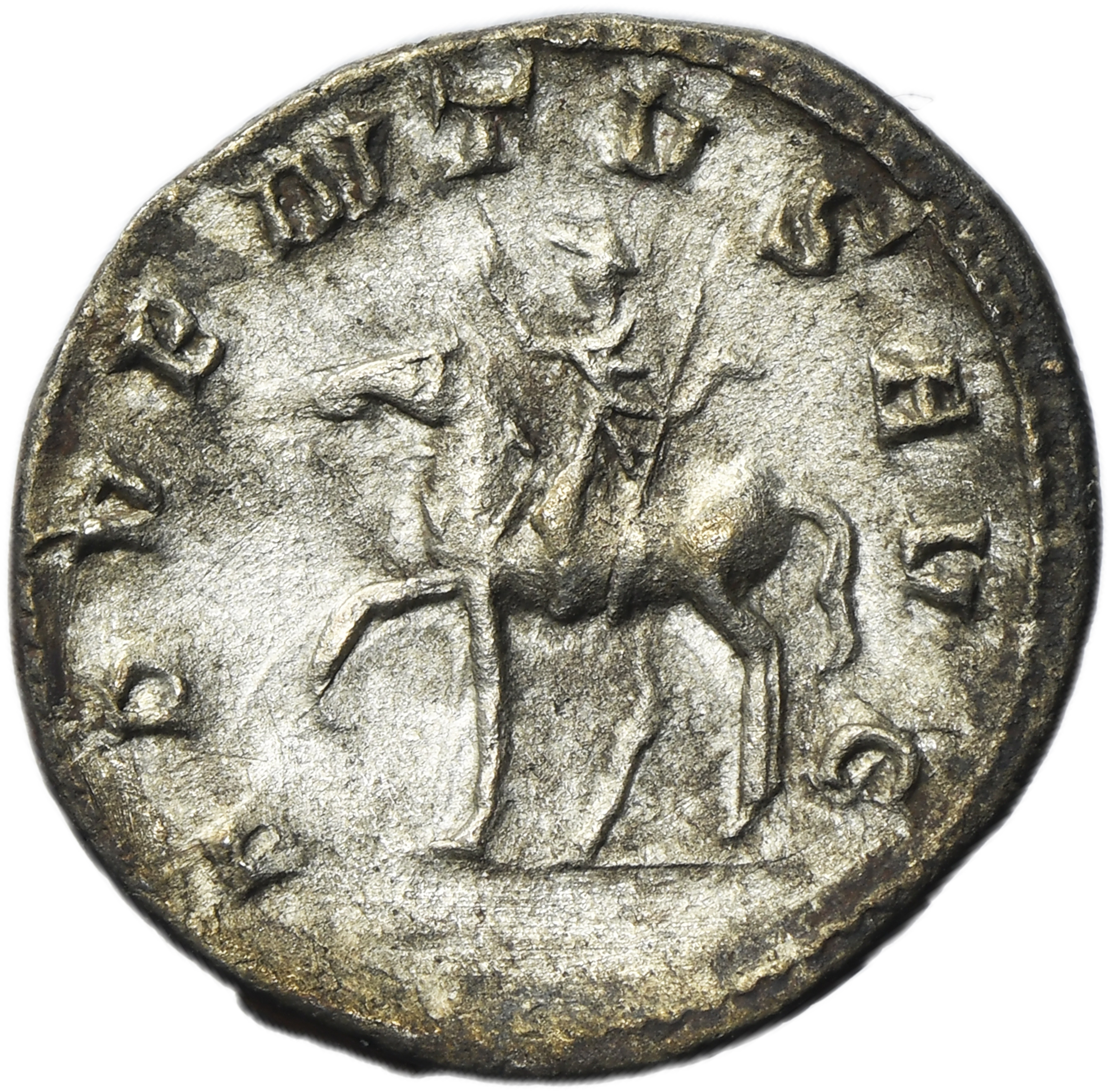


Antoninian of Trajan Decius (AD 249–251), struck at the Rome mint between AD 249–250, belongs to issues from the opening phase of his reign, produced shortly after his accession through military events in the Danubian provinces.
The obverse presents a radiate, draped and cuirassed bust of the emperor facing right, with the legend IMP C M Q TRAIANVS DECIVS AVG, giving his full titulature as imperator and augustus. The radiate crown denotes the antoninianus denomination, which at this time functioned as the principal silver coin in circulation despite its ongoing debasement.
The reverse shows the emperor on horseback riding left, holding a sceptre in his left hand and raising his right hand in a gesture of greeting or adlocutio, with the legend ADVENTVS AVG. This type belongs to a well-established iconographic tradition in Roman coinage and refers to the ceremonial arrival (adventus) of the emperor into a city, most commonly Rome or another administrative center.
The adventus motif carried strong propagandistic significance, emphasizing the legitimacy of imperial power and its public recognition. In the case of Trajan Decius proclaimed emperor by the army in the provinces the type takes on added importance as a visual affirmation of his formal entry into the sphere of central authority.
Roman Imperial
Trajan Decius (249-251), Antoninianus 249-250, Rome mint
Obverse: radiate, draped and cuirassed bust right
IMP C M Q TRAIANVS DECIVS AVG
Reverse: Decius on horse riding left, with left hand raised in salute and scepter in other arm
ADVENTVS AVG
Diameter 22 mm, weight 3.60 g











