Dimensions: 75 x 57 cm
Signature: signature p.d.: B. Biegas
Provenance
Poland, Desa Unicum private collection, auction 06.05.2021, item 15 Polswiss Art, auction 12.12.2017, item 28.
Exhibited
Płock, Mazovian Museum in Płock, Bolesław Biegas 1877-1954, exhibition on the occasion of the 60th anniversary of the artist's death, 5.06 - 6.07.2014. Płock, Mazovian Museum in Płock, Bolesław Biegas 1877-1954. Sculpture - Painting, 1997. Paris, exhibition at the artist's atelier at Rue Atelier du 3bis de la rue Jean Ferrandi, July 1949. Paris, exhibition at the artist's atelier at Rue de Bagneux 3 bis, Exposition des tableaux sphériques, 1948.
Reproduced
Bolesław Biegas 1877-1954 [exhibition catalog], published by the Mazovian Museum in Plock, Plock 2014, p. 14. Deryng X., Bolesław Biegas, published by the Polish Historical and Literary Society / Polish Library in Paris, Paris 2011, p. 146. Bolesław Biegas 1877-1954. Sculpture - painting [exhibition catalog], published by the Mazovian Museum in Plock / Polish Historical and Literary Society in Paris, Plock 1997, p. 51. Gelatin-silver print from the photographic establishment New York Times Photos at 37 Rue Caumartin in Paris, collection of the Polish Library in Paris, inv. no.: THL. BPP.Phot.Bieg.62.
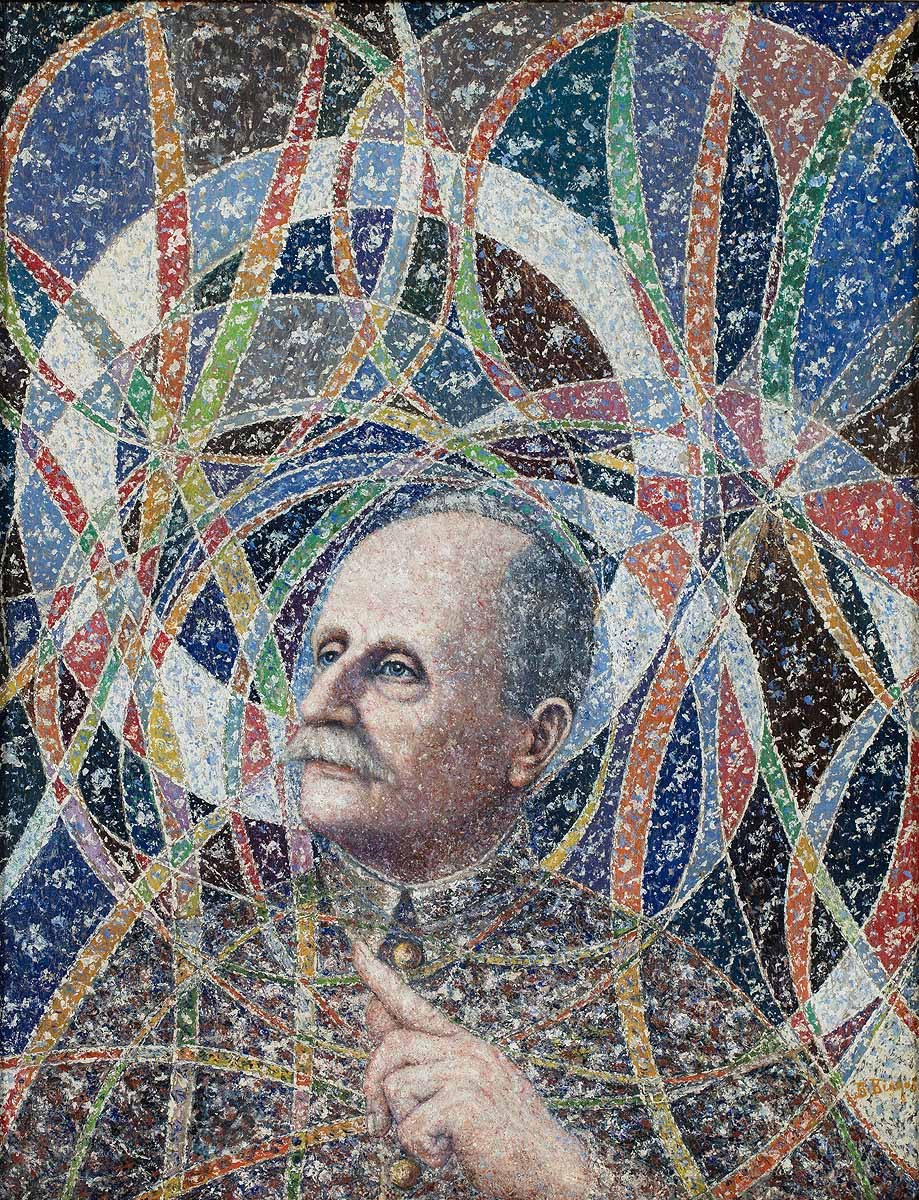
"Political skepticism determines Biegas' recent paintings, which create a series of personifications of nations, as well as portraits of the highest heads of state of countries involved in World War II. (...) These twenty paintings also represent the last extension of Spherism. However, they are different from the paintings of the 1920s, as the tangled circles appear only in the background. The circular networks blur, in effect, in the faces made using a pointillist structure. (...) The faces of the politicians have an expression that keeps you guessing about their beliefs, as if Biegas had placed defenders of democracy and dictators on the same plane. The smile of Stalin, whose head stands out in a red circle, is discreet, as is that of Churchill. Musolini and Hitler have the appearance of speaking to partisans who have not been persuaded by the Allies. (...) Poland is represented by two portraits, of Jozef Pilsudski, towards whom Biegas felt real admiration, and of Ignacy Paderweski. (...) Biegas will present his political portraits during the last exhibition he will hold in his studio between June 14 and July 7, 1949. (...) The exhibition included 18 political portraits, 18 personifications of nations and 18 spherical portraits. All 18 political portraits have reached our time. For that, there is no trace of the personification of nations. All the paintings have disappeared. Nor do they appear in the only existing photograph of this exhibition." - reports Xavier Deryng (Boleslaw Biegas, ARTgalerie, Paris 2011).
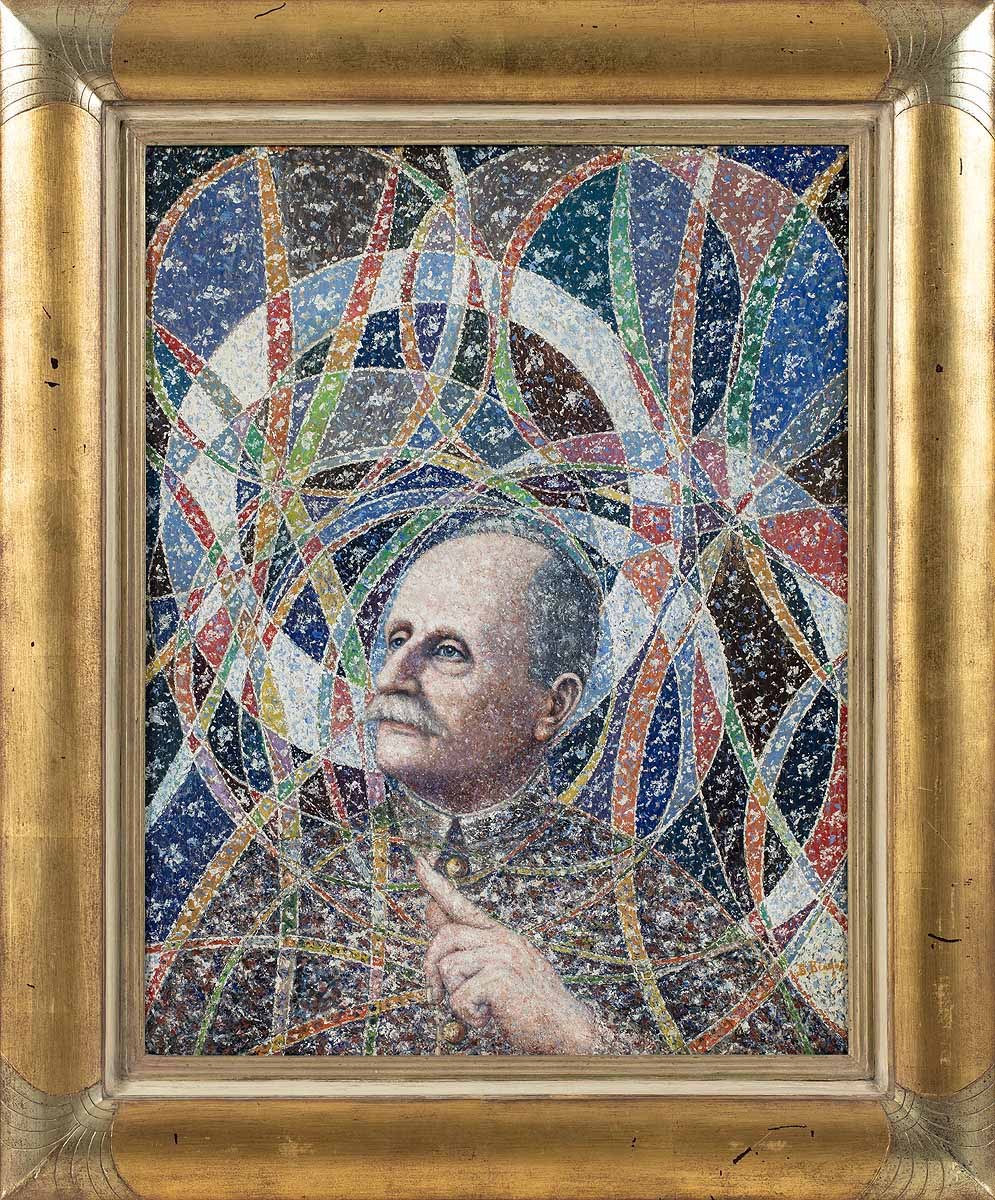
In one of the surviving photographs of the artist, he poses in his studio surrounded by numerous spherical paintings. We easily recognize the portraits of Paderewski and Clemenceau, two spherical paintings from the 1920s: "Tunhuz" - partially covered with a vase of flowers, and "Smile (Victory Dance)," as well as a portrait from a series of war leaders - General Michel Joseph Maunoury (1847 - 1923). Although the images in this series mainly depict figures related to World War II, several of them refer to the events of World War I, including the featured painting. Maunoury was a French general promoted posthumously to Marshal of France who played an important role in the French army. He served as War Governor of Paris from October 1910 and as a member of the Higher War Council from December 1910. General Maunoury's army contributed greatly to the victory at the Battle of the Marne in September 1914 and the final retreat of German forces. A year later, while in service, Maunoury was severely wounded by a shot to the eye and partially blinded, which directly ended his active career. The portrait on offer is a very rare collector's offering, documented, and from an extremely authoritative and scarce series.