


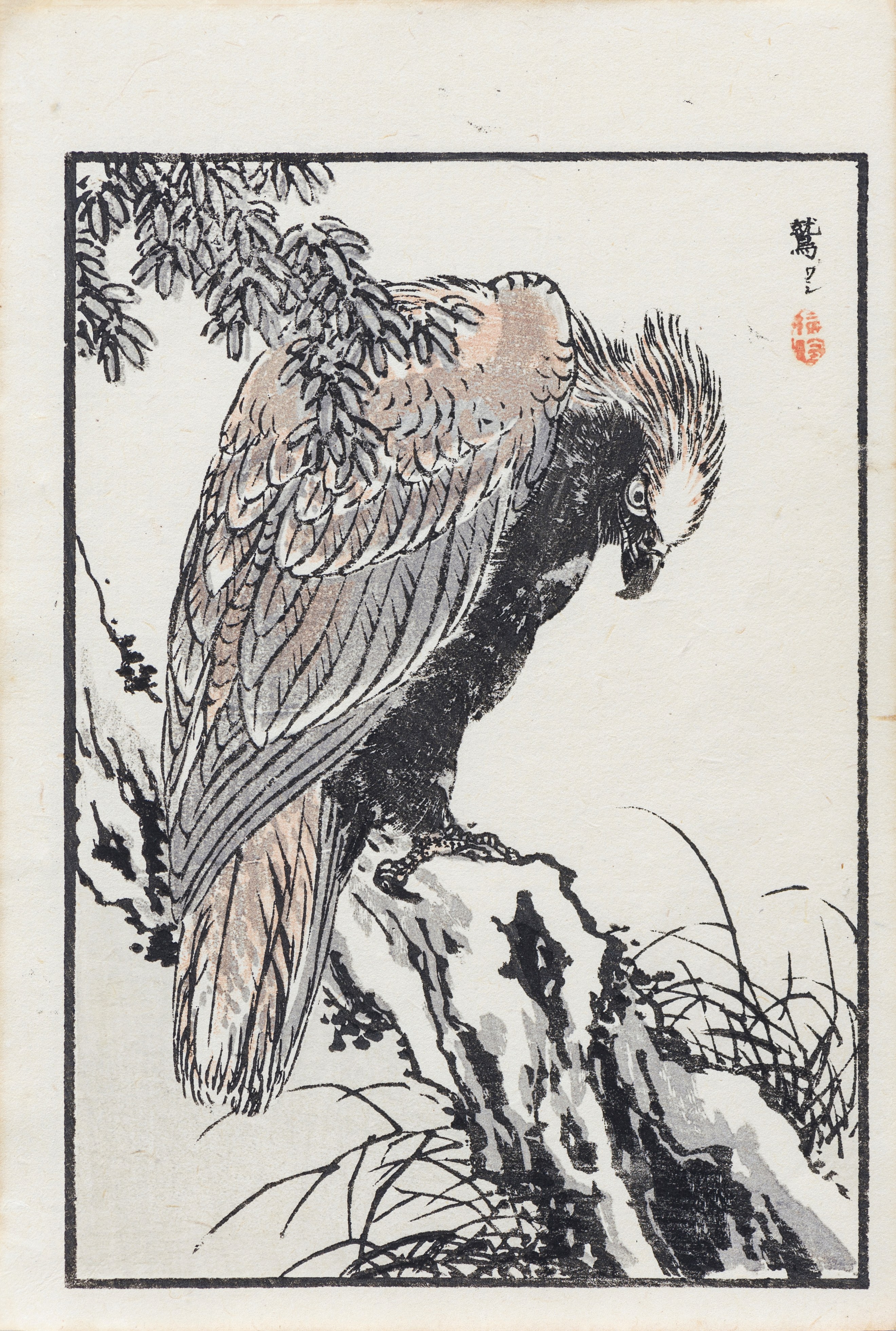
color woodcut, ink on paper, 25x16 cm, signed with a seal
The magnificent series *Illustrated Album of One Hundred Birds* by Bairei was published in three volumes in 1881 (Meiji 14), with a supplement containing new designs in 1884, also in three volumes. The volumes are titled Sky (Air), Earth, and Water. These beautiful woodblock prints depict birds in their natural habitats, among trees, flowers, and plants, throughout the different seasons. Carefully observed and drawn with fine calligraphic lines, these prints are an excellent example of Bairei kacho-e (bird-and-flower prints). The woodblock prints are executed in black with shades of gray and soft orange.
Volumes of the woodblock prints are held in the collections of the Metropolitan Museum of Art in New York, the British Museum in London, and the Art Institute of Chicago,among others. The publication is registered under number 40070693 at the National Diet Library in Japan.
Kōno Bairei (1844–1895) He was born Yasuda Bairei and lived in Kyoto. He was a member of the Maruyama-Shijo school and a master of kacho-go (bird-and-flower) painting during the Meiji period in Japan. In 1852, he began studying under the Maruyama school painter Nakajima Raisho (1796–1871). After Raisho’s death, Bairei studied under the Shijo school master Shiokawa Bunrin (1808–77). In 1880, he opened an art school, and his students included Takeuchi Seihō, Kawai Gyokudō, and Uemura Shōen. His works included prints of flowers, birds, and landscapes with a touch of Western realism. The artist’s most famous work is *Bairei hyakuchō gafu* (Bairei’s Album of One Hundred Birds), published between 1881 and 1884. In 1893, Bairei’s artistic and commercial success was honored with his appointment to the Imperial Court Art Committee.
The term kachō-ga in Japanese is a combination of three words: “ka” – flower, “cho” – bird, “ga” – painting, so it literally means paintings of flowers and birds. In Far Eastern art, it is one of the leading artistic themes. It also encompasses plants, grasses, trees, animals, fish, and insects—in fact, the entire living world of nature with the exception of humans and landscapes. Kacho-e prints were highly prized for their beauty and precision, and were widely collected both in Japan and abroad. The popularity of these prints stemmed in part from their reflection of traditional Japanese values and aesthetics, which placed great importance on harmony with nature. The woodblock prints were often imbued with symbolic and allegorical meaning, such as the association of certain birds or flowers with specific seasons or characteristics. The masters of kachō-ga were guided by both expression and emotion; they succeeded in capturing the colors and delicacy of flowers as well as the behavior of birds in the wild. Imbued with metaphorical meaning that transcended their physical beauty, specific pairings of birds, insects, and flowers became the foundation of a tradition that continues to this day.










