


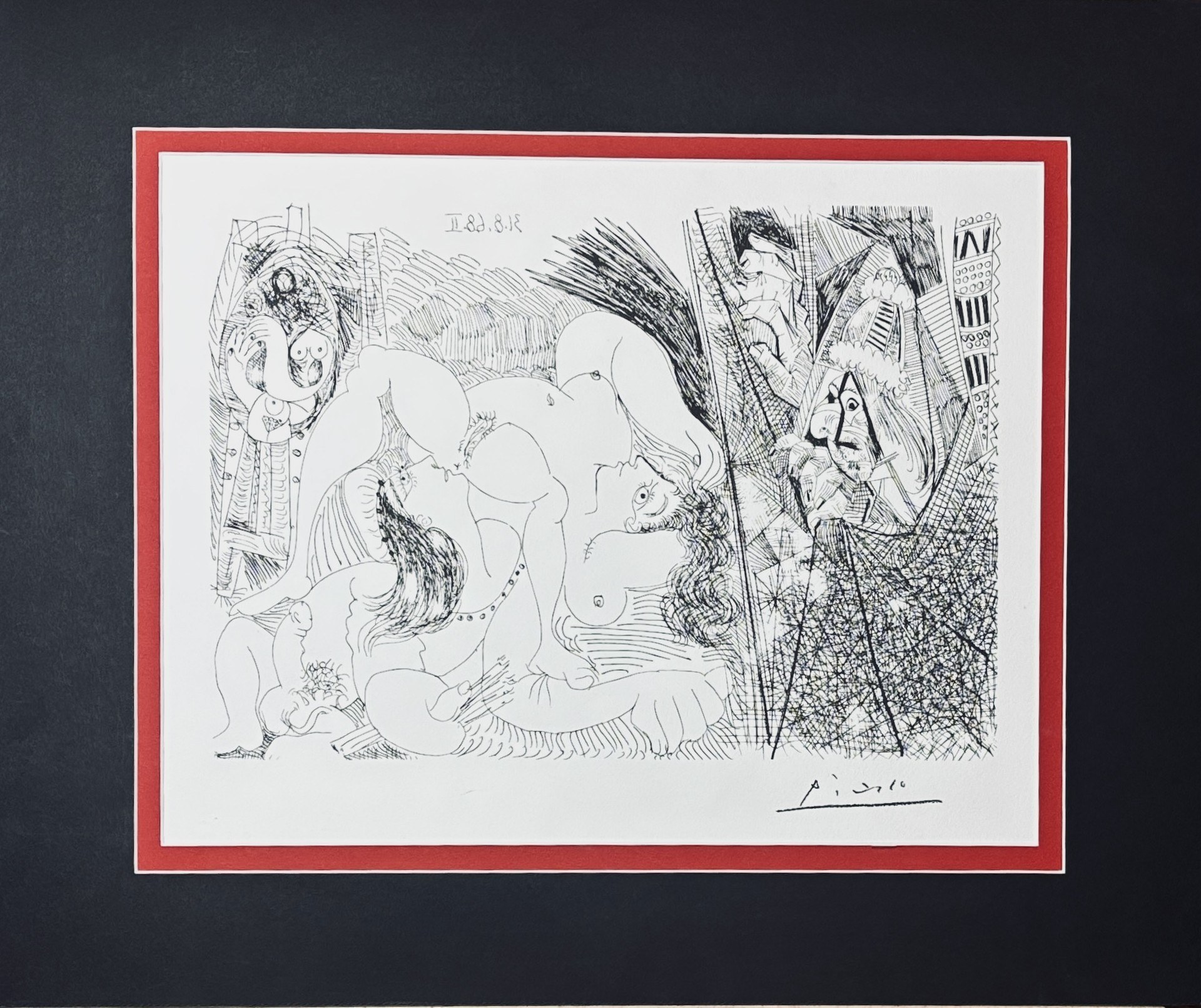
Lithograph from the “347 Drawings” series on Arches vellum paper, dimensions: 27 x 35 cm (inside the passe-partout), 40 x 48 cm framed: double mat, limited edition, unnumbered, signed on the stone in the lower right corner “Picasso,” date of creation “31.8.68.II,” (reversed inscription, imprinted on the stone) in the upper left corner.
Publisher: Cercle d'Art (Paris)
Ref: Bloch Catalogue Raisonné, pl. 29, series no. 347.
Between March 16 and October 5, 1968, secluded in his villa Notre-Dame-de-Vie in Mougins in southern France, the 86-year-old Pablo Picasso created a body of work that was absolutely unprecedented. In just 204 days, he completed an impressive series of 347 prints, creating a frenzied, erotic race against time and a desperate burst of energy from a brilliant old man. At that age, his waning virility inevitably clashed with his unquenchable libido and burning imagination. His response to this state of affairs was a ruthless, even maniacal obsession with sex, which transformed into a private theater. Sex in this series is not subtle—it is a volcanic explosion of desire, a whirlpool of bodies, exposed vaginas, and erect penises, where the act of creating art became a direct substitute for the sexual act, proving that as long as the artist creates with such vitality, he is still alive.
Throughout his life, Picasso drew energy from women—his wives and numerous lovers—from Fernande Olivier, through Marie-Thérèse Walter and Dora Maar, to Françoise Gilot and his then-current wife, Jacqueline Roque—and in the “347 Series,” all these muses return as sensual spirits and vivid memories. In this phantasmagorical world, mythological minotaurs, Spanish bullfighters, circus performers, and old masters such as Rembrandt and Raphael mingle with courtesans, creating a grand erotic spectacle.
Picasso himself viewed himself in this series with ruthless, almost painful honesty. Fully aware of his physical limitations, he cast himself in the role of a voyeur. In many of the paintings, he appears as a bearded dwarf, an old master in a stately ruff, or a melancholy old man brazenly gazing at young bodies entwined in a loving embrace. Although his role shifted from that of an active lover to that of a spectator, as an observer he retained full control over the flow of desire thanks to his talent.
When the series was presented in late 1968 in Paris and then in Chicago, it sparked a veritable moral scandal. Some of the works, due to their anatomical explicitness, were branded as pornography, and in some galleries, the most risqué prints were displayed in separate rooms reserved exclusively for adults. Confusion reigned among critics—many saw the series as nothing more than an eccentric, shameless whim of an old man and the self-indulgence of his own obsession. Over time, however, the true significance of this work was understood, and “Series 347” came to be recognized as one of the most moving and audacious graphic diaries in the history of art—a poignant record of the fear of transience cloaked in the garb of unbridled eroticism.










Recentemente visualizados
Efetue login para ver a lista de itens
Preferidos
Efetue login para ver a lista de itens