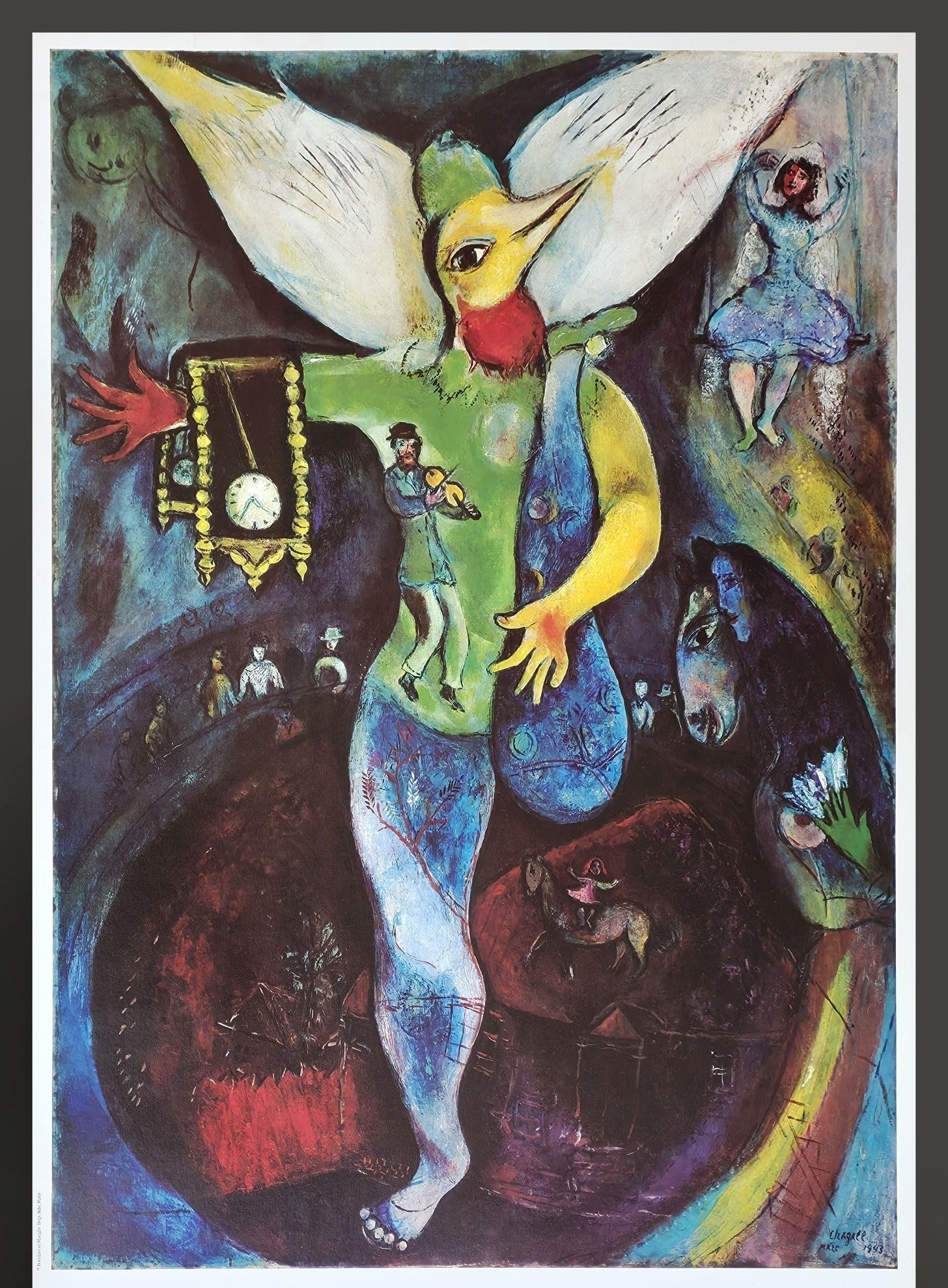
Color offset lithograph, 56 x 43 cm;
From the limited, official exhibition edition of “Rétrospective Marc Chagall, Fondation Maeght, 1984”
Publisher: Fondation Maeght; lithographed at the renowned Parisian studio Imprimerie ARTE (Maeght Éditeur).
A major retrospective of Chagall’s work (Rétrospective Marc Chagall / Rétrospective de l’œuvre peint) took place at the Fondation Maeght in Saint-Paul-de-Vence from July 3 to October 15, 1984.
During the preparations for and the course of the retrospective in July 1984, Marc Chagall lived near the foundation and personally oversaw the events organized by his longtime friends and publishers—the Maeght family.
Chagall had been collaborating with Aimé and Marguerite Maeght since 1950. He was one of the key artists associated with the foundation from the moment it opened in 1964 (he created, among other works, a large wall mosaic for the foundation). The retrospective in July 1984 was the culmination of this decades-long friendship and creative collaboration, taking place just a few months before the artist’s death. A year after this major artistic event, Marc Chagall died at the age of 97.
*Le Jongleur* is one of Chagall’s most intriguing, dramatic, and multi-layered works.
The central figure has the body of a human but the head of a bird with yellow plumage and a rooster’s comb. It also has large, white wings—the wings of an angel or a bird—spread out at the top of the composition. This hybrid figure (half-human, half-animal/angel) juggles not objects, but symbols of human fate, time, and emotions.
In his right hand, the juggler holds—or “suspends in the air”—a golden clock with a pendulum. Juggling time signifies an attempt to master the chaos of the world through art. Inside the juggler’s torso/chest is a small musician in a top hat, and at the top right is an acrobat on a trapeze.
This is one of Chagall’s most recognizable motifs—the circus motif. For Chagall, the circus was a metaphor for human life—full of spectacle and poetry, but also of profound tragedy, of feigning joy in the face of suffering.
As he himself wrote: “The circus seems to me to be the most tragic spectacle on earth [...] it is humanity’s cry in search of entertainment and joy.”